

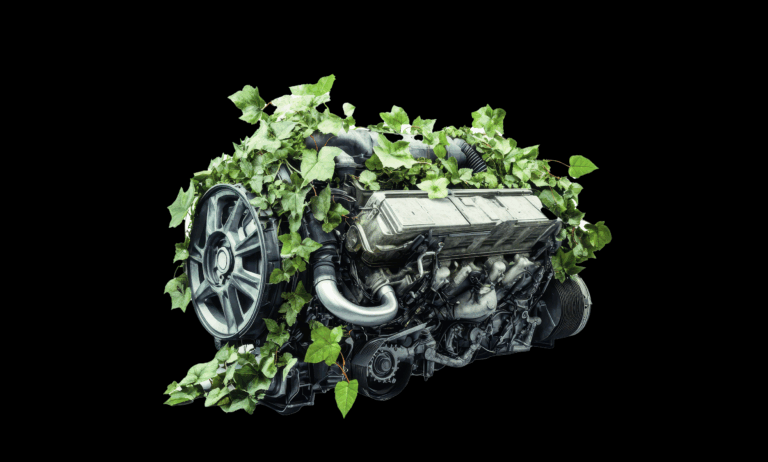
While battery vehicles often grab the headlines, the internal combustion engine is still a vital part of the energy transition in the off-highway sector, with efficient diesel, dual-fuel, hydrogen combustion and hybrid solutions being developed
As the construction and mining industries seek to reduce their carbon footprint, manufacturers are developing innovative engine technologies that maintain power and reliability while cutting emissions. From dual-fuel hydrogen solutions to full hydrogen combustion engines, these developments are accelerating the transition to zero-emissions in off-highway applications.
Volvo Penta and CMB are collaborating on a dual-fuel hydrogen solution for both land and marine applications. This partnership builds on successful pilot projects dating back to 2017, during which Volvo Penta engines were adapted to run on both hydrogen and diesel using CMB technology.
The new collaboration leverages Volvo Penta’s established Stage V D8 engine platform, enhanced with CMB’s hydrogen injection system. Hydrogen is released from storage tanks, brought to low pressure, and injected into the engine’s air intake. This reduces the amount of diesel required to produce the same energy output, reducing CO2 emissions while maintaining performance. “The whole Volvo Group is working intensively to explore solutions to reduce, and ultimately eliminate, greenhouse gas emissions,” says Heléne Mellquist, president of Volvo Penta. “We are teaming up with suppliers, partners, and customers to accelerate the journey into fossil-free fuels for both on land and at sea applications.”
An advantage of the dual-fuel solution is its fallback capability. If hydrogen is not available, the application can continue running on traditional fuel. This makes it particularly suitable as a transitional technology while hydrogen infrastructure develops. “This is a solution where you use hydrogen and diesel in combination,” says Ann Parmar, VP marketing at Volvo Penta. “It’s not the full hydrogen engine, where you need to build it from scratch.”

“From the initial dual-fuel technology projects we have seen reductions of CO2 emissions up to 80%” says Roy Campe, CTO of CMB. “It is clear that the energy transition is a major challenge in many types of applications. With the dual-fuel technology we have been developing over the last few years, we can provide a cost-effective and robust solution for a variety of applications.”
Full hydrogen combustion
While Volvo Penta focuses on dual-fuel technology, JCB is taking a different approach with its £100 million investment in fully hydrogen-powered combustion engines. After three years of development by a team of 150 engineers, JCB recently announced the official certification for its engine for commercial use in 11 European countries. “It is a significant moment for JCB,” says JCB chairman Lord Bamford. “To start 2025 with certification in place in so many European countries bodes very well for the future of hydrogen combustion technology. JCB has proved in recent years that it is a proper zero emissions solution for a wide range of construction and agricultural vehicles.”

JCB has already produced over 130 evaluation engines powering backhoe loaders, Loadall telescopic handlers and generator sets. Moreover, 2024 saw over 50,000 hours of hydrogen engine testing. JCB also completed more than 25,000 km of on-road testing at the request of the UK Government to demonstrate that hydrogen-powered machines are safe for use on British roads.
“Five years ago, hydrogen combustion engine technology was not even on the radar, and now it is being approved and endorsed by governments. This is truly remarkable, but it is only the beginning,” says JCB’s group director for special projects, Tim Burnhope.

Pathways to sustainability
Liebherr is pursuing multiple avenues for reducing emissions in off-highway applications including an expanded diesel engine portfolio, advanced hydrogen engine development, and research into ammonia as an alternative fuel.
At Bauma 2025, Liebherr unveiled its new D9612 diesel engine, delivering a maximum power output of 950kW for demanding off-road applications, particularly focusing on agricultural machinery. The company also showcased innovative technology like its hydraulic air boosting system which improves engine dynamics and efficiency. “In our machines, we transmit power using pressurised hydraulic fluid,” says Bouzid Seba, head of pre-development at Liebherr Machines Bulle. “Certain movements require the release of pressure, which results in energy loss. Our innovation does not only allow to recover and store this energy, but also to use it subsequently on demand in our hydraulic air booster. When needed, the air booster pushes large quantities of air into the motor to help it deliver power quickly,.
Liebherr’s components product segment has also invested significantly in hydrogen engine development and testing facilities. Since 2020, prototype engines have undergone rigorous testing, and the company is currently evaluating different injection and combustion technologies. This includes port fuel injection (PFI) and direct injection (DI).
To future-proof its portfolio further, Liebherr showcased a concept ammonia engine at Bauma 2025. Green ammonia serves as a hydrogen carrier, offering reduced transportation and storage costs. The company suggests that generators and off-highway powertrains fuelled by green ammonia could provide low- or zero-emission solutions, particularly for mining.
Hybrid power expansion
Caterpillar Industrial Power Systems is advancing its electrification strategy with the introduction of its Series Hybrid Power Expansion powertrain, combining diesel-electric and battery technology to optimise power efficiency and reduce emissions.
Also launched at Bauma, the new powertrain operates through an integrated system where a Cat engine drives a generator to convert mechanical energy into electrical power. An inverter then manages power distribution from both the generator and battery to the electric motors that drive the machine. This setup allows the battery to store unused energy for peak power demands, enhancing system efficiency.

“This is an ideal solution to meet the current needs of many of our customers,” says Steve Ferguson, senior vice president of Caterpillar Industrial Power Systems. “Combining the engine and battery provides higher power capability than using either an engine or battery alone. This allows for control optimisation to distribute power from multiple sources, maximising powertrain efficiency. Customers benefit considerably from reduced downtime, improved fuel efficiency, and lowered repair frequency, minimising the total cost of ownership.”
The hybrid powertrain system consists of five key components working in harmony. The engine serves as the primary power source, providing mechanical power to the generator. This system is designed to be compatible with engines across the Caterpillar range, including future developments running on alternative fuels. The generator is closely coupled to the engine and selected to align with engine capabilities to provide electrical power.
At the heart of the system is the inverter, the central component that manages energy from the generator or battery and distributes it to the motors. It can also accept recuperated energy from the motors to recharge the battery. The motor converts electrical output from the inverter into the required torque and speed. Additionally, the motors are capable of absorbing mechanical energy and transform it into electrical output for braking and regeneration.
Completing the system is the battery, which stores excess energy from the engine or regenerative energy from the motors, providing rapid power response to meet critical cycle requirements. It can supplement engine power or act as the sole power source when needed.
The hybrid capability allows for zero-exhaust emissions when running on battery power. Additionally, with appropriate equipment, the Series Hybrid Power Expansion powertrain can function as a mobile power source with export capability.
Beyond hybrid technology, Caterpillar is actively developing hydrogen solutions for its engines. A team of engineers is testing various alternative fuels, including hydrogen, methane, methanol and ethanol. “We’re doing this work now. This means when our customers are ready to move to hydrogen or other fuels, we will be able to provide them with our deep expertise and learning to ensure a smooth adoption,” says Luke Bennett, Caterpillar product specialist.
At Bauma, Caterpillar demonstrated its hydrogen development progress through a simulated test cell environment for the C18, a gas engine converted to run on hydrogen.
“We’ve been operating it on low and high ambient temperatures and looking at the vibration effects of the engine, which is how we investigate alternative fuels in the evolving energy landscape. We’re using what we’ve learned from this technology for our other engines in development,” says Bennett.
A greener future
It’s clear that whether through improving the efficiency of diesel combustion, implementing alternative fuel solutions or combining electric power in hybrid powertrains, the internal combustion engine still has a very important role to play in the drive to decarbonise off-highway.
The development of these technologies highlights how different approaches can be taken to achieving the same goal: reducing emissions while maintaining performance and reliability. What unites them is the recognition that the industry needs practical, reliable solutions that can be implemented in the real-world, as Burnhope highlights: “It’s not just about what is written on paper; it’s about real machines working on real job sites, making a real difference to the industry.”
This article first appeared in the June issue of iVT