

Advanced AI is driving intelligent automation for excavators and loaders worldwide, delivering productivity gains while addressing critical labour shortages facing the industry. We speak to the experts who explain how it is done
Autonomous technologies are increasingly reshaping the construction landscape. From remote-controlled dozers operating in hazardous environments to AI-powered systems optimising earth-moving operations, the industry is witnessing a technological revolution that promises to redefine productivity, safety and operational efficiency. While mining has long embraced autonomous haul trucks and drilling systems, construction sites – with their dynamic conditions and constantly changing project specifications – present far greater challenges for automation. Yet it is precisely within this complexity that the greatest opportunities lie. Leading this charge by bringing intelligent automation to excavators and loaders across construction sites worldwide is Swiss company, Gravis Robotics.

Founded as a technical university spin-out from ETH Zurich, Gravis Robotics benefits from Switzerland’s thriving robotics industry – the country has major investment from global technology companies such as Google and Anthropic. Ryan Luke Johns, Gravis Robotics’ CEO, describes the company’s unconventional origins. “We grew out of a lab that was applying AI-based control to quadruped (four-legged) robots, and started looking into transferring that technology to the Menzi Muck walking excavator,” he says. “Eventually we migrated this advanced control onto more conventional hydraulic machines.”
The tech behind the transformation
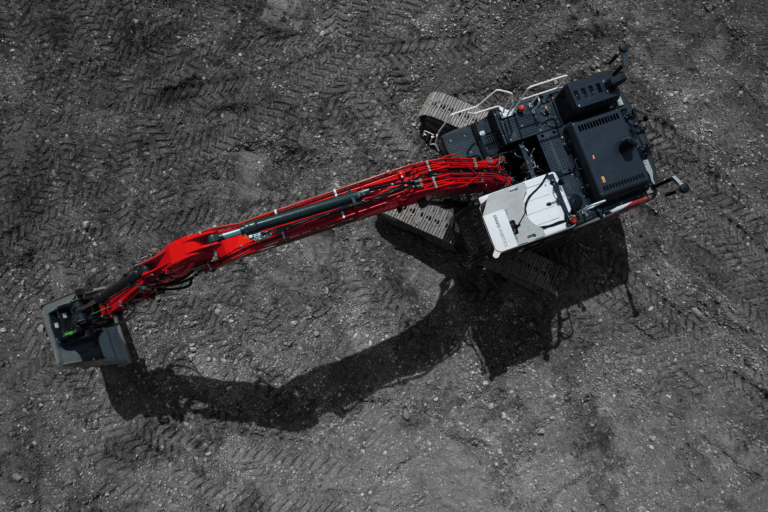
At the heart of Gravis Robotics’ solution lies its retrofit kit – the Rack. This system integrates five surround-view cameras, lidar sensors for 3D sensing, onboard computing power, GPS positioning and a wireless tablet interface called Slate. The technology transforms conventional excavators and loaders into intelligent machines capable of autonomous operation while maintaining full manual control capabilities.
“Only the most highly skilled and experienced operator could match the accuracy of an autonomous system”
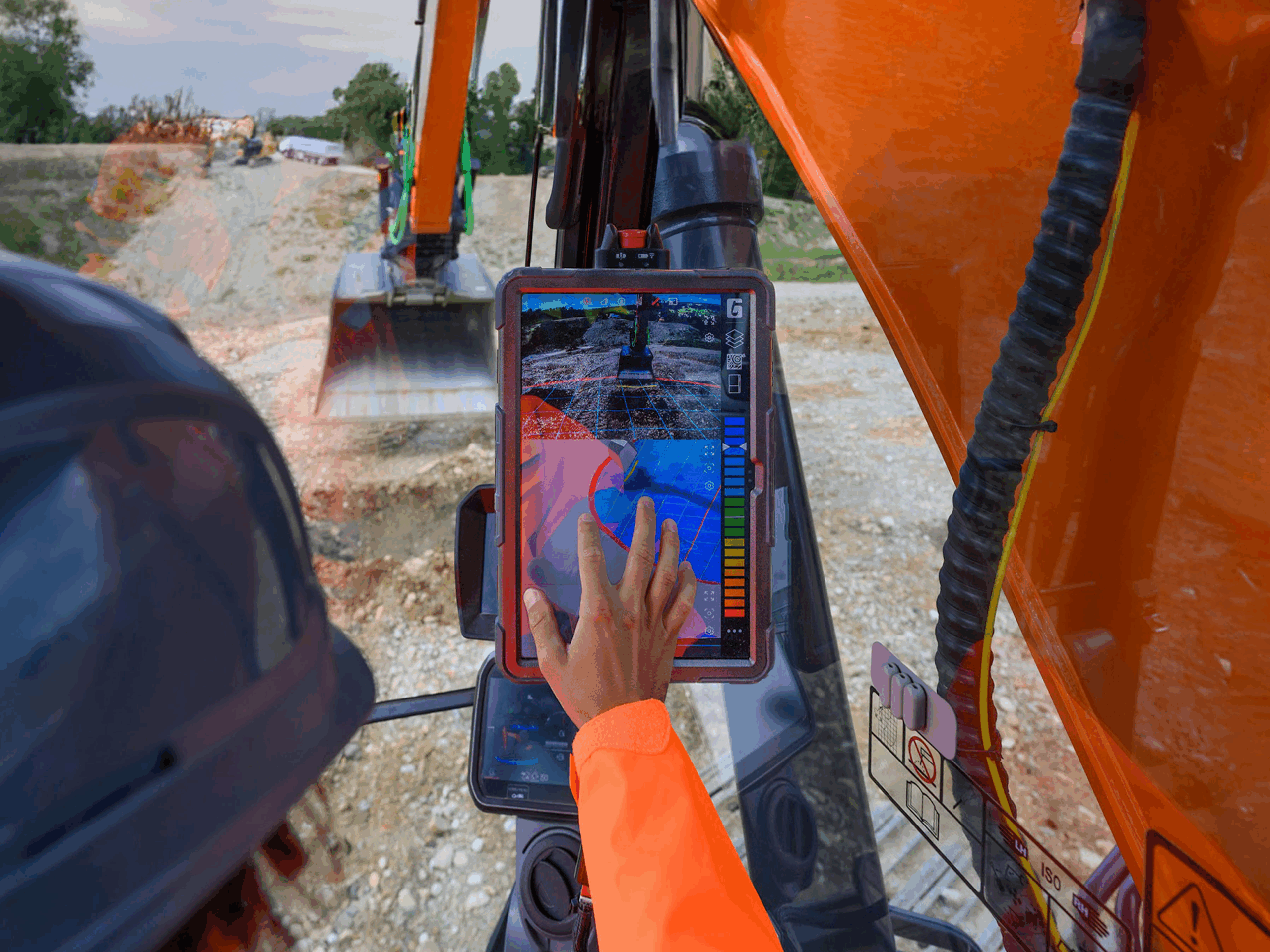
The Slate tablet represents a crucial innovation in user interface design. Unlike traditional machine-control systems that display cryptic grade information, Slate provides intuitive, real-time 3D visualisation. Blue areas indicate where material needs removing, green shows on-grade areas and yellow or red highlights sections requiring fill. This visual system updates continuously as work progresses, providing operators with immediate feedback whether working autonomously or manually.
The system’s intelligence stems from machine learning algorithms trained in simulated environments across countless terrain conditions. Rather than relying on rule-based systems, the AI learns to optimise digging strategies by analysing soil hardness through hydraulic pressure data, terrain shapes, and GPS information. The result is a system that consistently achieves full bucket loads whilst adapting to varying ground conditions – from soft earth to hidden rocks –often outperforming experienced operators in specific tasks.
“When the ground is really soft, it takes a very full scoop,” says Johns. “When there’s a rock hidden that it can’t see, it gently feels it and still comes up with a full scoop without getting stuck.” This sensitivity translates into consistent cycle times and productivity gains that can reach 30% improvement over manual operation in bench-marked scenarios.
The convergence of several technological factors made Gravis Robotics’ vision viable. “The large opportunity in automotive self-driving has facilitated a massive drop in the cost of hardware such as lidar, cameras, and edge computing,” says Johns. “There’s also been a boost in abilities with AI, enabling machines to adapt to the complexities of the ground and the worksite.”
Gravis Robotics, however, had to address the challenge of integrating its solution with different hydraulic systems. “The behaviour of hydraulic systems can vary between OEMs, size-classes, and interfaces,” says Johns. “Performance can even differ between two machines of the same make and model or on the same physical machine over time. Our solution is able to adapt to these differences to maximise productive control of the machine. We offer interface solutions that support both electrohydraulic machines or conventional hydraulic pilot stage machines. The challenge, and the key value in our AI-native approach, is to have one autonomous agent that can adapt to these variations. Our learning-based AI adapts to the unique characteristics of each machine’s hydraulics and geometry, letting one software solution work across different pumps and hydraulic configurations.”
As the adoption of autonomy in construction has increased, OEMs are now shifting toward electrohydraulic machines. “Transitioning to electronic joystick signals from conventional hydraulic pilot stage control makes it easier for us to plug-in a retrofit computer and directly control machines,” says Johns.
Driving OEM adoption
Since its first work with Menzi Muck, Gravis Robotics has secured collaborations with major construction OEMs, as demonstrated at Bauma in April 2025. The company showcased autonomous truck loading at Develon’s booth, demoed live teleoperation with Menzi Muck, unveiled an autonomous loader with Case, were on display at Sumitomo’s booth, and hosted an autonomous Yanmar machine at the Gravis booth.
One of the key partnerships for Gravis Robotics was with KTEG, a joint venture between Hitachi Construction Machinery and Kiesel Technologie Entwicklung, a subsidiary of the Hitachi dealer for Germany, Austria and Poland.
The collaboration on the ZE135 battery-powered excavator demonstrated how autonomous technologies can integrate with other industry trends, particularly electrification. “In our demo area at Bauma, the machine operated autonomously,” says Timo Vestweber, marketing and sales support manager at KTEG. “It received its work instructions, such as excavating a trench, via a tablet and executed them independently. The combination of zero-emission technology and artificial intelligence elevates the KTEG ZE135 to a new level of innovation and demonstrates the future of autonomous, emission-free construction,”
Addressing industry concerns
From labour shortages to productivity demands, the construction industry faces challenges that autonomous technology seeks to address, as Johns explains. “When people think about autonomy in this industry, they think the first goal should be to remove the human operator in the cab. However, our goal is to increase productivity – to move more earth while reducing inefficiency and rework from manual grade checking. If we look at the demands of the industry, the declining labour productivity and lack of workers –this is a huge need. Our goal is to drive productivity to be 30% faster, and if that’s 50% autonomy and 50% augmentation or 90% autonomy and 10% augmentation – that’s great for the customer because they’re able to get more throughput with the operators they have.”
“Our learning AI adapts to the unique characteristics of each machine’s hydraulics and geometry, letting one software solution work across different configurations”
Although autonomous excavators are still in the development phase, Vestweber echoes Johns’ recognition of the potential of these technologies to address productivity concerns. “They have the potential to work around the clock which will reduce project completion time, allow contractors to make better use of resources and save money – it also means they can take on more jobs, increasing profitability,” says Vestweber. “Efficiencies are also to be found in the execution of the work. Only the most highly skilled and experienced operator could match the accuracy of an autonomous system, for example when it comes to excavating the precise amount of materials to be removed from a site. Plus, by harnessing big data, they will be able to assess their own performance and enable predictive maintenance.”
In terms of safety concerns for operators, Vestweber highlights how autonomous machines can play their part in keeping accident rates to a minimum. “Operators would no longer be exposed to hazardous working conditions. Autonomous machines would also not make mistakes due to operator fatigue.”
Expanding adoption
Gravis Robotics’ emphasis on excavators and loaders reflects market realities – these machines represent around 90% of construction equipment sales by volume, excluding haul trucks. With machines now deployed across Switzerland, Germany, Netherlands, Japan, the UK and US, Gravis Robotics focuses on expanding deployments to gather operational data across diverse site conditions and machine types. “The industry response has been encouraging,” says Johns. “There’s a strong understanding that the market is moving to autonomy. It’s now a question of how we get those systems to the end-users fast enough to get the feedback we need to understand how we’re collectively incorporating the technology into the site, and how we’re shaping the landscape of the future.”
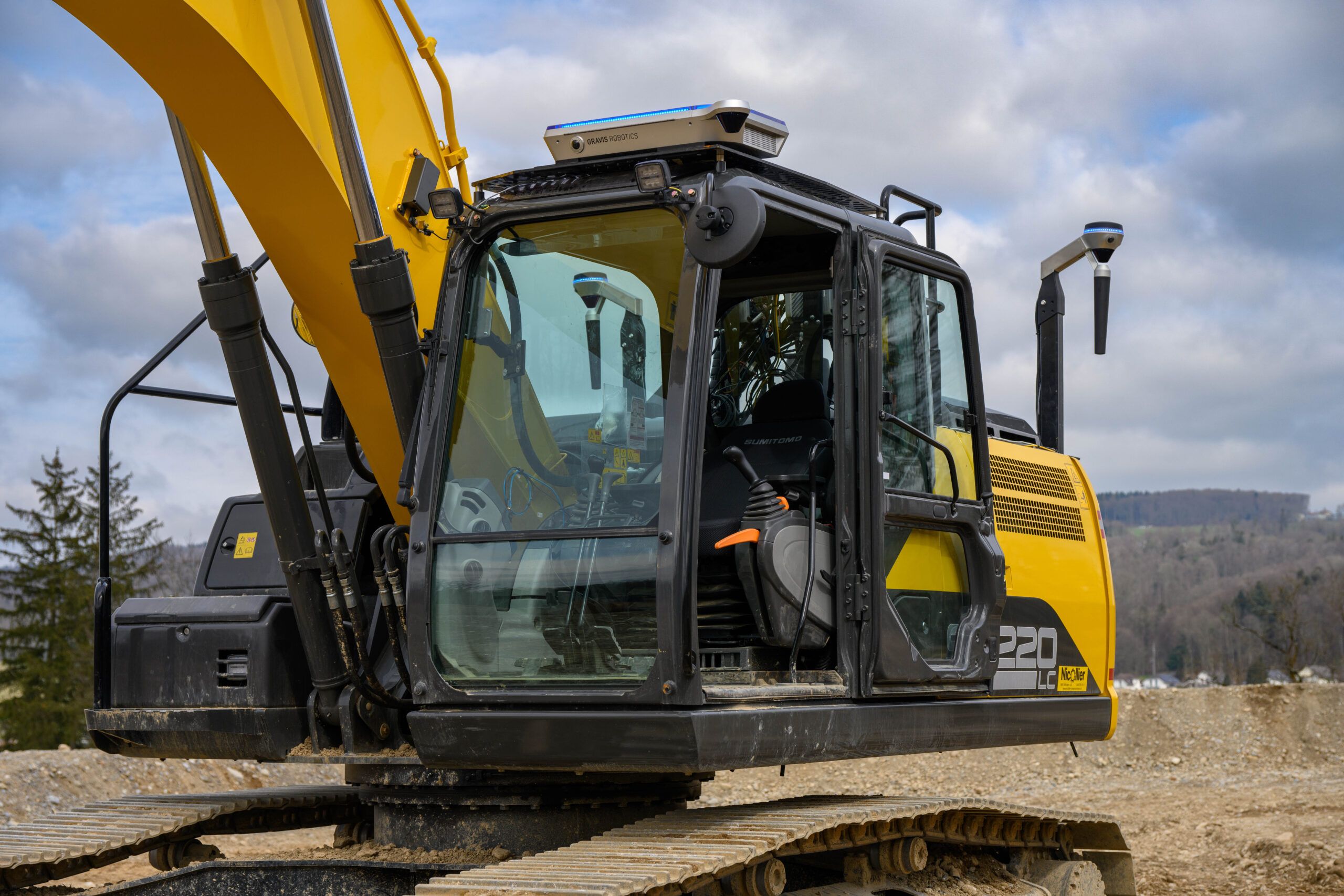
This widespread deployment extends beyond individual machine performance. “What benefits the system is large deployments over many sites with many types of machines,” says Johns. “So we’re really able to look across the board and say ‘Yes, we are consistently able to deliver increased productivity’.”
Looking forward, KTEG sees potential for scaling autonomous systems to larger machines where the economic benefits become more pronounced. “The cost of autonomous systems would be similar when it is in smaller models,” says Vestweber. “But in terms of production – as in the amount of material moved per hour – it will become more cost-effective in larger excavators.”
An autonomous future
The collaboration between technology companies and established OEMs signals a new era for construction equipment. “The core motivation for the end users and OEMs is to have an early grasp on the future of autonomy,” says Johns. “We’re making sure that the right players are at the table to bring the most value and driving the industry forward. It’s a very exciting time for everyone involved.”
As the construction industry grapples with labour shortages and productivity demands, autonomous technology offers a pathway forward. Through operator-friendly solutions that augment rather than replace human capability, the future of construction lies not in eliminating the human element, but in intelligently enhancing it to achieve previously impossible levels of efficiency and precision.
This article first appeared in the October issue of iVT