

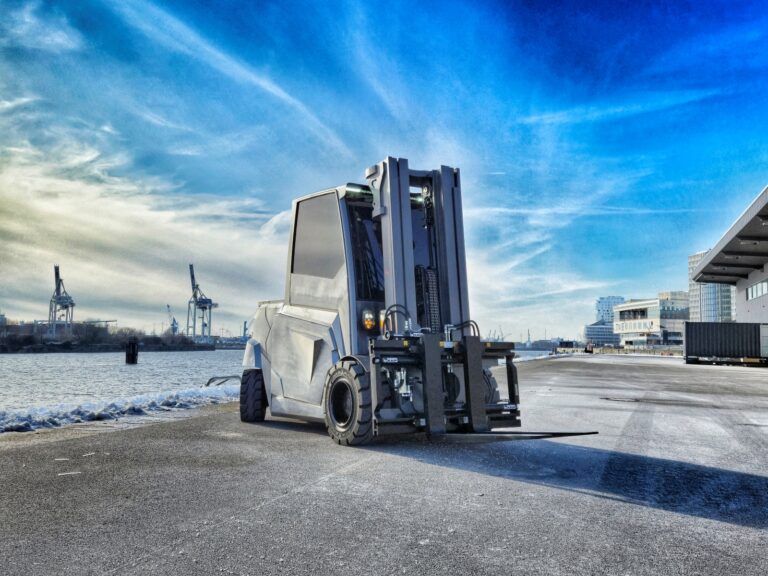
Jungheinrich has introduced the FalcOn, an electric counterbalance forklift truck designed for performance-intensive, heavy-duty material handling applications. Based on the current EFG Series 5, the vehicle was developed to test the integration of high-voltage technology under realistic operating conditions.
The FalcOn targets application scenarios where electric forklifts have previously reached their limits, such as heavy loads, long inclines and continuous outdoor use in demanding climatic conditions. It is aimed at industries including beverage, building materials and automotive supply logistics, where combustion engine vehicles still predominate.
“With the FalcOn, we want to show that electric forklifts can be a real alternative to combustion engines even in the toughest operating profiles,” says Andreas Schiller, global portfolio lead counterbalance heavy trucks at Jungheinrich. “To this end, we have developed a completely new, optimally coordinated overall system that is unique in this form. The counterbalance truck is visible proof of the performance potential of high-voltage technology.”
The FalcOn is designed for a load capacity of 6,000kg with a load centre of 600mm. Combined with dynamic acceleration and a driving speed of up to 26km/h, the vehicle reaches the 15m mark in around 4.6 seconds with a load and around 4.0 seconds without. Lifting speed under load is 0.6m/s, supporting high-frequency lifting and lowering operations in continuous use.
A key element of the truck’s availability is the fast-charging capability of the high-voltage system. The FalcOn can be charged with direct current at capacities of up to 150kW via an automotive-compliant CCS-2 interface. In practice, a window of around 30 minutes is sufficient to charge the battery from around 20% to 80%, suited to multi-shift applications with short downtimes.
At the core of the drive concept is an actively cooled high-voltage system in which all central drive components are water-cooled, maintaining stable power output under high continuous loads and elevated outside temperatures. The truck also features individually controlled wheel motors, enabling precise response and reversing behaviour during frequent direction changes.
“It is not just the voltage level that is decisive, but the interaction of all components,” says Dr Jasper Schnack, project manager for the development of the FalcOn at Jungheinrich. “Only through active cooling, a suitable system architecture and precise application can high-voltage technology really play to its full potential in the heavy forklift segment.”
The FalcOn was displayed at LogiMAT 2026, and the company is preparing the next stage of the project, in which selected customers will be involved in the further development of the heavy-duty electric forklift truck with high-voltage technology.
“Our aim is to work with customers to find out how this technology can be meaningfully transferred to real-world applications in the future,” says Schiller. “The FalcOn marks an important starting point for this.”
Image: Jungheinrich