

‘We need a highway bill, we need certainty, and we need the next generation’: AEM’s Kip Eideberg on the challenges for the industry at ConExpo 2026
As the doors open on North America’s biggest construction equipment show, the AEM (Association of Equipment Manufacturers’) senior vice president is calling for federal funding for highway construction, certainty in trade policy and creative solutions to the workforce crisis – while remaining cautiously optimistic about the road ahead.
ConExpo-Con/Agg has always had a way of generating excitement regardless of what is happening in the wider world. Even in a year defined by geopolitical uncertainty, tariff turbulence and anxious debates about the future of domestic manufacturing, the Las Vegas show floor feels, as Kip Eideberg puts it, like a place where optimism is simply baked in.
“I’m exaggerating, but I think the rest of the world could be on fire and everyone at ConExpo would still be super excited,” he laughs. “It is just a special show for the industry.”
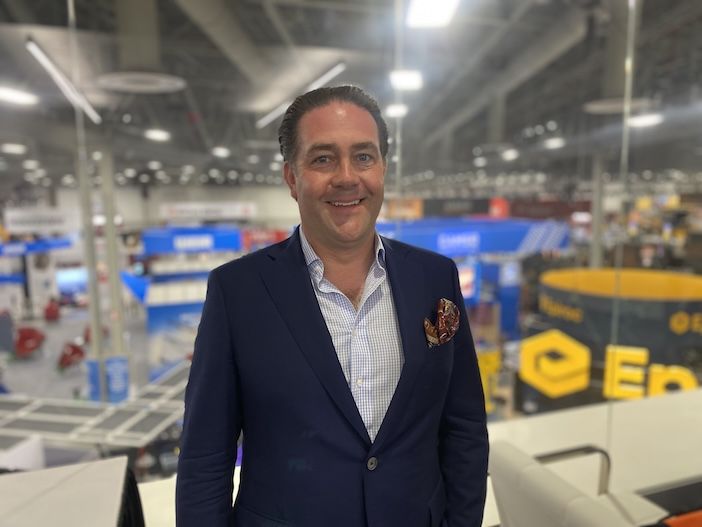
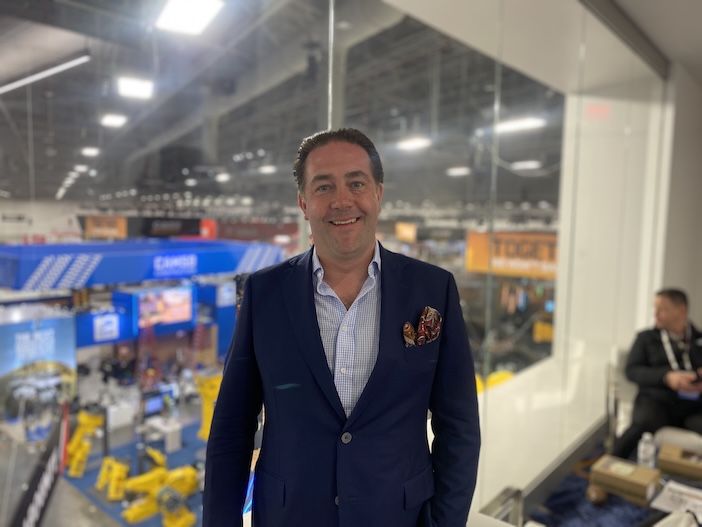
But Eideberg, senior vice president of the Association of Equipment Manufacturers (AEM) — the body that owns and organises the triennial event — is not here merely to celebrate. He is here with a mission. And at the top of his agenda is a message that he and his colleagues will be driving hard throughout the week: the US needs a new highway bill, and it needs one now.
A triennial snapshot — and a mixed picture
To mark the opening of ConExpo 2026, AEM has released its triennial economic impact report, compiled by S&P Global Insights. The report offers a comprehensive picture of the equipment manufacturing sector, covering job numbers, GDP contributions, tax revenue, average salaries and overall economic impact. The findings, Eideberg explains, tell a story of resilience tempered by real concern.
“We still support 2.2 million jobs across the United States,” he says. “That’s around 10% of total US manufacturing, and about 1.4% of total US employment. So it is a significant slice of the economy.” However, that figure represents a marginal contraction of 0.2% compared with the previous report, a trend mirrored in sales data. “I’ll be honest, I was expecting a bit more growth,” he admits. “There’s been a lot of talk from both this administration and the previous one about bringing manufacturing back and bolstering competitiveness. You might have expected a jump. It hasn’t quite materialised yet.”
There is, however, a genuinely positive headline buried in the numbers. The average salary in equipment manufacturing has crossed the six-figure threshold for the first time, reaching $105,000 — 50% above the US national average. “We’ve always talked about how these are great, family-sustaining jobs,” Eideberg says. “Now we have the numbers to back that up. These are careers worth pursuing.”
The highway bill: a race against the clock
The most pressing concern for the industry right now is not a tariff or a trade deal. It is the looming expiry of the Infrastructure Investment and Jobs Act — the landmark legislation shepherded through Congress by the Biden administration that has underpinned a significant wave of infrastructure spending across the country. That funding is set to run out this year.
“Surface transportation funding runs on a five-year cycle,” Eideberg explains. “Congress has to reauthorise it, and that reauthorisation is due this year. We need a new highway bill. If that doesn’t happen, the industry is going to feel it.”
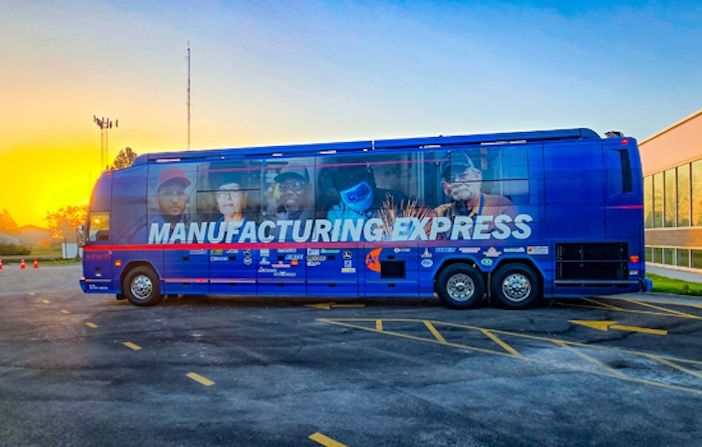
This is the centrepiece of AEM’s advocacy effort at ConExpo. The organisation has brought its AEM Manufacturing Express — a purpose-wrapped touring bus that has criss-crossed the country since its 2024 launch, visiting equipment manufacturers and telling the story of the industry — to the festival grounds for the duration of the show. Parked beside AEM’s I Make America campaign hub, it serves as a focal point for a major grassroots lobbying push targeting Capitol Hill.
“The goal is to send somewhere between 30,000 and 35,000 emails to Congress during the course of the week,” Eideberg says. “When people come to the booth, they can find out about the policies we need, join the I Make America campaign, and send a message directly to their House representative and their two senators. I think that kind of volume will be felt in Washington.”
The effort is being amplified by a series of high-profile political visits. The Governor of Nevada is scheduled to tour the show on Thursday, while Friday and Saturday will see a full delegation of House of Representatives members, senior congressional staff, and — in a particularly significant appointment — US Secretary of Labor Lori Chavez-DeRemer.
“She has a programme to create a million new apprenticeship opportunities,” Eideberg notes. “So there’s going to be a lot of conversation about workforce, about jobs, about what the industry is doing with technology and innovation. It’s a real opportunity.”
The tariff rollercoaster
Alongside the highway bill, the other major cloud hanging over the industry is trade policy — specifically, the ongoing uncertainty around tariffs. Eideberg is careful to note that the industry has, to some degree, learned to adapt to the trade environment established during the first Trump administration. But the current climate of rapid change is creating its own set of problems.
“The Supreme Court striking down the IEEPA tariffs was good news,” he says. “But we already have a 15% global tariff in place, and there’s uncertainty about what comes next. It’s a real rollercoaster, and what industry executives tell us, consistently, is that they need certainty more than anything else. Fifty per cent tariffs on critical parts and components — that’s crippling. That will be a drag on the industry and will ensure that we don’t invest as much in domestic manufacturing capacity.”
He acknowledges that some tariffs from the first administration have now been absorbed into the market and adapted to. “As long as we can get some certainty — trade agreements, a clear picture of what the tariffs look like, ideally bringing some of them down — and combine that with dedicated funding streams for infrastructure, then the industry has a real platform for growth.”
The concern, he says, is that 2025 and 2026 represent a defining moment. “If we can navigate through the current challenges — the geopolitical environment, the trade policy uncertainty — and come out stronger, then we’re in good shape. But if we look back at 2026 from the vantage point of 2027, it could look like a rather grim year for the industry. We’re optimistic. But we’re also clear-eyed.”
42,000 jobs, and nowhere near enough people to fill them
Even if every policy challenge were resolved tomorrow, Eideberg warns, the industry would still face a problem it cannot legislate away: a chronic and deepening shortage of skilled workers.
The economic impact report reveals that the equipment manufacturing sector currently has a shortfall of 42,000 workers — roles that companies would fill immediately if the candidates existed. And unlike the job numbers, this gap is not contracting. It is growing.
“We could hire 42,000 more people tomorrow if we could find them,” Eideberg says. “And that’s a troubling skills gap, because it doesn’t matter how good the tax code is, or how favourable the trade agreements are, if there isn’t a skilled workforce to build the equipment. That’s what is keeping executives up at night.”
The structural drivers are stark. Many of the counties where equipment manufacturing is most concentrated are experiencing negative population growth. The existing workforce is ageing, and the broader US economy faces an estimated shortfall of two and a half million workers as the baby boomer generation retires. In some areas, the response has been a destructive cycle of companies poaching from one another rather than growing the overall talent pool.
“You see people jumping for an extra five dollars an hour, then jumping back again. That’s not how you build a robust, skilled workforce,” he says. “We need to figure this out as a country — not just as an industry. That means parents, educators, lawmakers, business leaders. We all have a role in making careers in manufacturing more attractive to young people, to older workers considering a career change, to everyone.”
The average salary figure — $105,000, well above the national mean — is one of the most powerful tools in that argument. But awareness remains a challenge, and Eideberg believes that events like ConExpo have a vital part to play in changing perceptions.
“Getting people to a show like this, seeing the technology, the innovation, the scale of what this industry does — that has an impact. We’ve got to get them here, and then let the industry speak for itself.”
A bus, a mission and a very busy week
It is, by any measure, a packed schedule for Eideberg and the AEM team. The Manufacturing Express bus — its sides wrapped with images of manufacturing workers and the American flag — will be a constant presence on the festival grounds throughout the week, drawing visitors into conversations about policy, careers and the future of the industry. Alongside the congressional visits, there are product launches, member engagements, press commitments and the sheer spectacle of the show itself to contend with.
“This is my fourth ConExpo,” Eideberg reflects, “and we have more initiatives going than ever before. It used to be that you could actually spend time touring the show. Now, I’m looking at the schedule wondering when I’ll get the chance.”
For now, though, the bus is parked, the hats are ready, and 35,000 emails are waiting to be sent. Washington, it seems, is about to hear from Las Vegas.
Kip Eideberg is senior vice president of government and industry relations at the Association of Equipment Manufacturers (AEM). The AEM Manufacturing Express is located on the festival grounds at ConExpo-Con/Agg 2026, Las Vegas.