

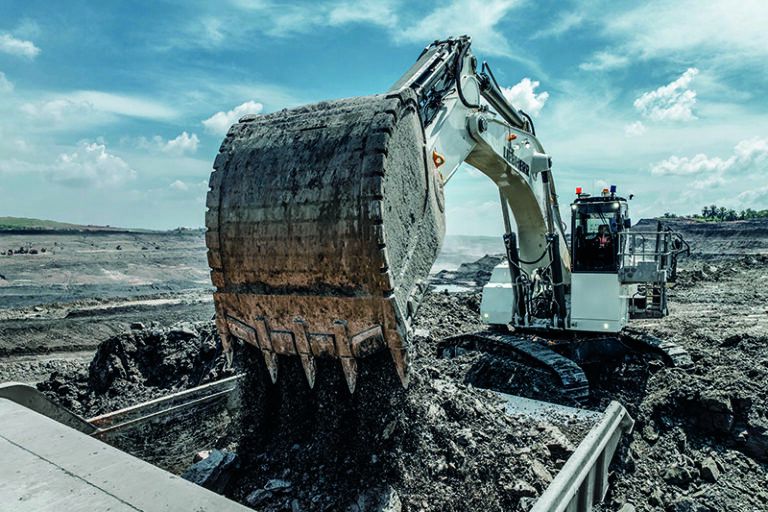
Liebherr’s new 100-tonne 9100 excavator – the lightest so far in the Generation 8 mining rollout – adds new electronic architecture, a reworked hydraulic system and boasts fuel savings of up to 20%
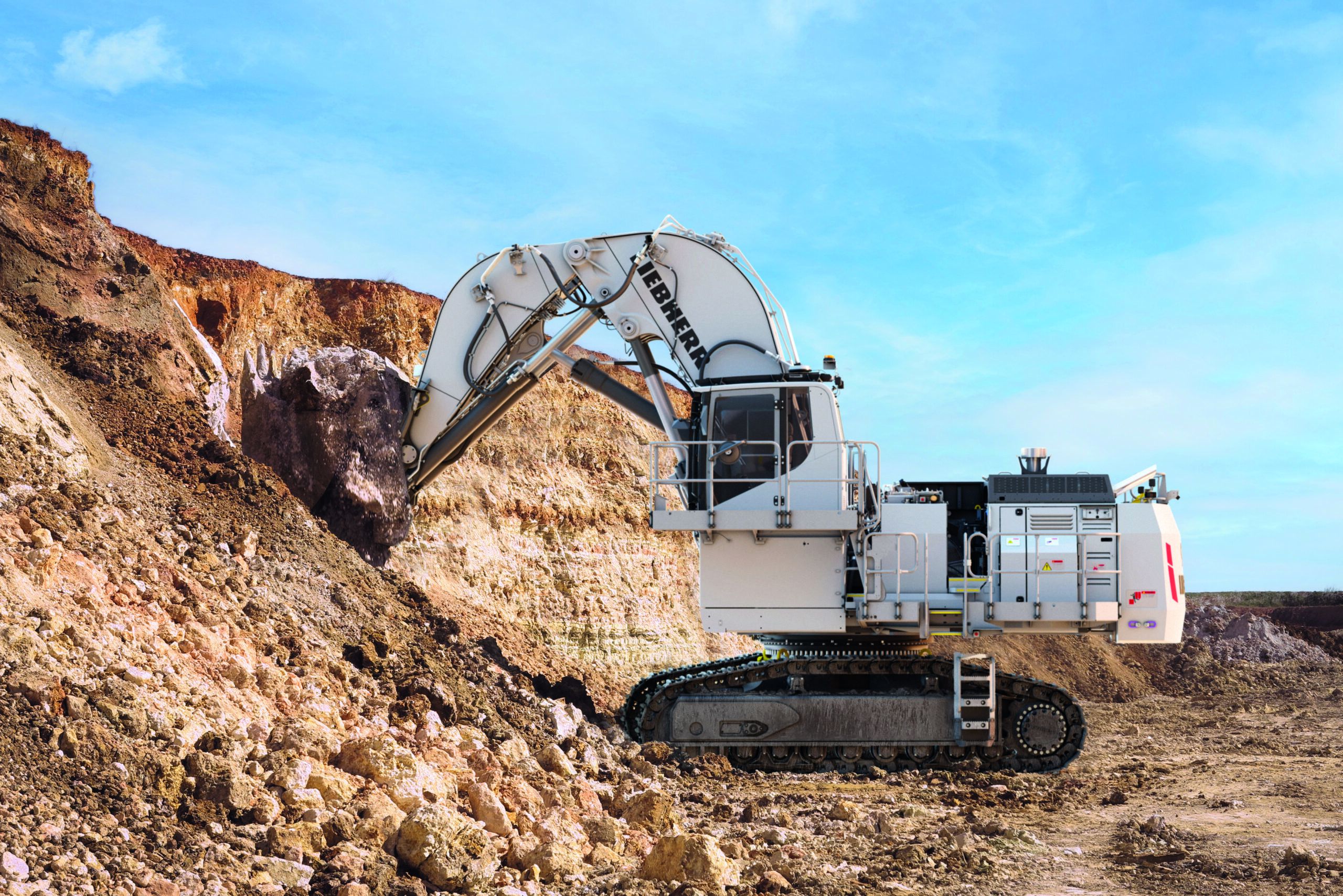
The newest machine in Liebherr’s mining excavator portfolio is also the smallest. Launched in March, the R 9100 Generation 8 is a 100-tonne mining excavator that replaces the existing R 9100 Generation 6, with series production of the backhoe and front shovel configuration scheduled for Q2 and Q3 2026 respectively.
It is the third machine in Liebherr’s Generation 8 rollout in the mining class, after the R 9600 and R 9300, and the upgrade is best understood as an evolution rather than a redesign. The cab is carried over from the Generation 6, the D9512 engine is retained, and bucket capacities are unchanged. What has changed sits beneath the panels: a new electronic architecture, a redesigned hydraulic circuit with electro-hydraulic control, for smoother more-precise operation and Liebherr Power Efficiency (LPE) for both the engine and the hydraulics.
For Michel Runser, head of product management for hydraulic excavators at Liebherr Mining, the launch is the next step in a generational cycle measured in six to eight-year increments. “We are not filling a gap. We are just continuously bringing new models and new generations to market,” he says.
A new electronic backbone
Two pressures shaped the Generation 8 architecture. The first was the obsolescence of the previous-generation control hardware. The second was the demands of IoMine — the name of Liebherr Mining’s technology product portfolio, covering the Skyview 360-degree vision system, bucket filling assistant, truck loading assistant, performance monitoring and data services — which needs a more capable backbone than the Generation 6 was built around.
The electronic redesign was the single biggest engineering task on the machine, driven as much by longevity as by performance. “Today you can assume that approximately every two or three years, some of the electronic components inside of a control board will change and evolve,” says Runser. “We have to be prepared to make this change over the years.” The Generation 8 platform has been engineered to absorb that turnover without forcing a complete redesign each cycle.
Liebherr Power Efficiency
Sitting on top of that architecture is LPE, the OEM’s engine and hydraulic management system. LPE is split into two control strands: one governing the engine, the other the hydraulics. The aim was to understand in detail how the two interact — how hydraulic demand shapes powertrain behaviour and vice versa. On the R 9100 Generation 8, LPE is credited with a 20% reduction in fuel consumption and a 30% improvement in fuel efficiency compared with the Generation 6 – savings that Liebherr puts at up to 100,000 litres per year. “You have the hydraulic demand on one hand, and you have the powertrain on the other hand,” Runser says. “It’s the combination of both which is really a big benefit.”
The distinction between fuel reduction and productivity preservation matters, in Runser’s view. “Before, all the OEMs provided an eco mode which was really simple. You reduce the engine RPM to save fuel,” he says. “In reducing the engine RPM, you’re also reducing the performance of the machine because it becomes slower.” As a result, the operator saves fuel, but the job takes longer to complete. In the end, the overall fuel consumption per task isn’t necessarily improved.
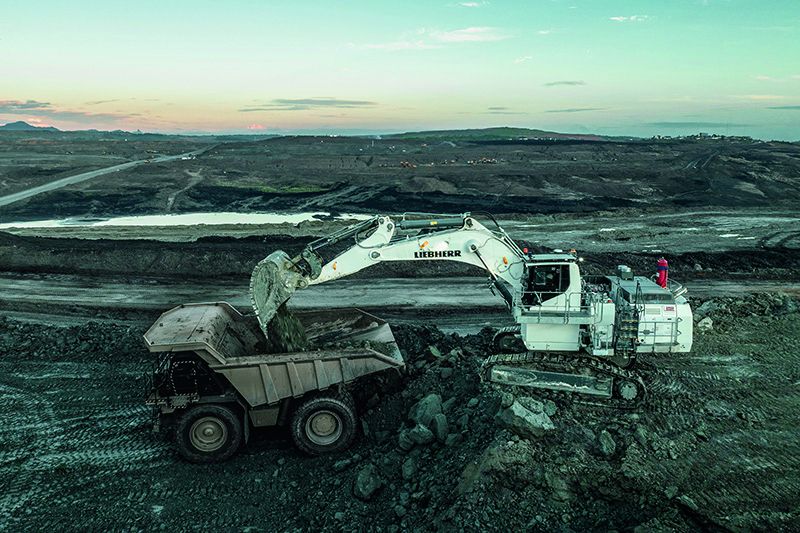
Fuel economy carries real weight in this class. Liebherr cites fuel as accounting for up to 40% of operating costs for a 100-tonne excavator, and Runser notes that ongoing volatility in diesel prices has sharpened customer focus on consumption. A pre-series R 9100 Generation 8 working at the Tanjung Enim mine in South Sumatra, Indonesia, bore out the numbers in the field: an instantaneous production study in September 2025 recorded a fuel efficiency ratio of 9 bank cubic metres per litre, based on a production rate of 771.2 bank cubic metres (1,589 tonnes) per hour and fuel consumption of 85.7 litres per hour.
Invisible hydraulics, lighter steel
The hydraulic circuit on the Generation 8 has been optimised to reduce pressure losses and improve cycle times, but from the operator’s seat the experience is intended to be seamless. There are no modes to toggle and no tuning to configure.
“The hydraulic system is completely transparent to the operator,” says Runser. “With the advanced electronics and all the hardware we have installed, the system is capable of knowing exactly what the machine is doing. It can adjust the speed, the torque, the pressure and the flow of the different elements.”
The steel structure has also been revised. The boom and stick have been redesigned to trim weight, drawing on new simulation tools and a shift towards robot welding in the factory. Runser is careful not to overstate the gains, the savings are in single-digit percentages rather than double, but every kilogram removed from the dead weight translates into either additional payload or greater reserve in the hydraulics.
Other hardware-level changes include integrated IMUs for cylinder dampening, a redesigned undercarriage with lifetime-sealed travel drives as standard, and grease change intervals extended to a minimum of 250 operating hours.
Assistance over autonomy
The bucket filling assistant is intended to reproduce the behaviour of an experienced operator. “It continuously monitors the attachment speed, the cylinder pressure, the angles. It can calculate the centre of gravity of the load,” Runser says. “As soon as the system detects a potential bucket stalling, it will adjust the position. It’s done within milliseconds.”
Feedback from the field has centred on fatigue reduction across a shift as much as on outright productivity gains – a benefit that extends to seasoned operators as well as inexperienced ones.
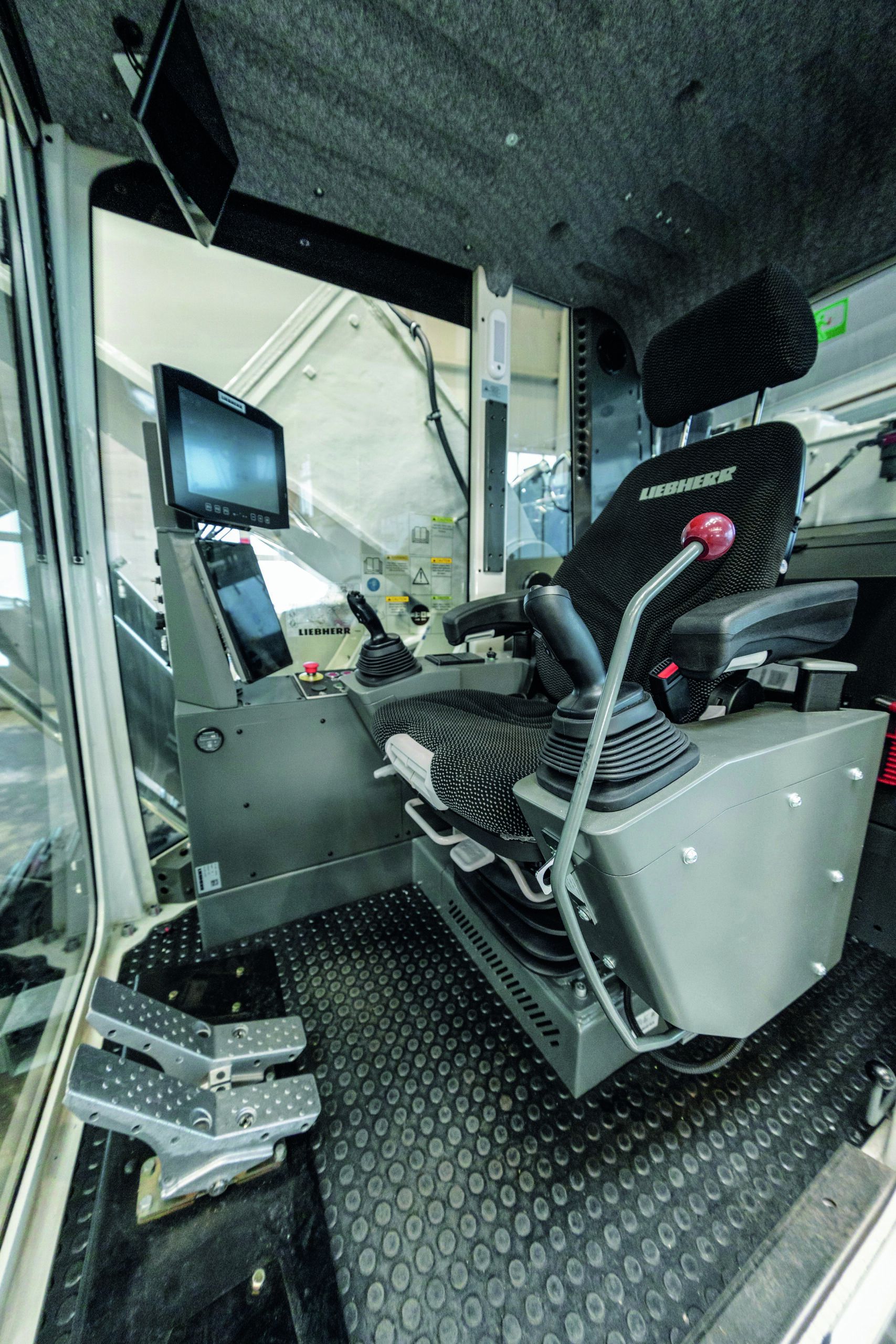
A companion feature, the truck loading assistant, is an onboard weighing system that pairs with an RFID-based truck recognition setup. Each truck is identified as it approaches, the system consults its payload profile, and the operator is told how many passes are required for a full load. “The aim and the target for every single customer is not to overload the truck, because if you’re overloading the truck, you could have issues with the frame or the braking,” Runser says. Under-loading, meanwhile, leaves fuel potential on the table.
“As soon as the system detects a potential bucket stalling, it will adjust the position. It’s done within milliseconds”
Full autonomy is not on the immediate roadmap for the R 9100. Runser sees more near-term value in remote control, which Liebherr is currently testing at its factory. Excavators, in his view, are harder to automate than haul trucks. A truck runs a fixed route between two known points; an excavator operator is making constant judgement calls about the material and the working face in front of them. “The operator view and the operator sense and the feeling of the operator is something you cannot really easily replace,” he says. “The first step is really to focus on remote control, and full autonomy will come later.”
Operator safety
Safety upgrades on the Generation 8 span both digital and mechanical measures. The Skyview system condenses the machine’s all-round view into a single top-down display, which Runser says has proved particularly useful in topside loading configurations, where the haul truck is on the same level as the excavator rather than below it.
Fire protection is integrated from the design phase rather than bolted on afterwards. An Ansul fire suppression system is interconnected with the machine’s electronics to shut down the engine and bring fans to zero RPM in the event of a fire. Design guidelines also specify firewalls, covers and catch trays across the portfolio. “Fire protection is a really big topic, especially for the miners, because you can very quickly lose a complete asset,” says Runser.
The hybrid question
With a global 100-tonne market not requiring an electric machine, Liebherr will not offer this variant.
Hybrid technologies, however, are under active investigation. Runser places further fuel consumption reductions at the top of his priority list for future generations, alongside maturing remote control. Work with Liebherr-Components on hybrid engine concepts and alternative hydraulic technologies is already feeding into the planning for Generation 9 and Generation 10.
A steady evolution
The underlying message is steady evolution rather than disruption. The R 9100 is the smallest mining machine Liebherr makes, and much of what is visible, the cab, the engine, the bucket sizes, is carried over. But the electronic architecture, the electrohydraulic control and the fuel efficiency gains are where the real work has been done, and where Generation 8 earned its designation.
This article first appeared in the May/June issue of iVT