

Over the past decade fluid-power transmissions that are able to deliver both fine control and high road speed have been developed for telehandlers – successfully blending abilities of powershift torque converters and hydrostatic drives. But the ways in which has been achieved vary. As the sector evolves, we take a look at some of the leading solutions
Since the advent of dedicated material handlers for agricultural and construction use, the ideal method of propulsion has divided the sector. While the principles of lifting and shifting objects and commodities are common to both industries, farm telehandlers tend to spend much more time travelling from A to B. Then there are frequent direction changes required when loading, and the need to climb slopes and push into heaps of grain, manure and silage.
So while both torque converter and hydrostatic transmissions have their place, OEMs have increasingly looked to designs that combine the best characteristics of both, and hence help users tackle a wider range of tasks. Farm work demands the torque transfer capability of mechanical drive to provide high levels of tractive power, but also the infinitely-variable speed control and inching capability of a fluid-driven hydrostatic system.
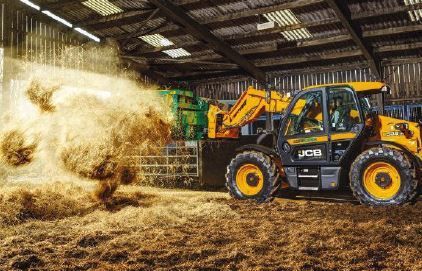
Research by JCB indicates that, on average, farm telehandlers spend 60% of their time on actual handling work, while 35% is spent on towing and/or road work. Idling accounts for the remaining 5%. With this in mind JCB launched its DualTech VT transmission in 2016, which has been since rolled out across its range.
“Previously, telehandler buyers had to choose between a powershift machine for speed and towing capacity or a hydrostatic machine for manoeuvres and precise speed control,” says Tim Burnhope, JCB’s managing director. “Each option involved compromise, until the development and launch of DualTech VT, which combines the low-speed controllability and easy driving characteristics of hydrostatic with the higher speed efficiency of direct drive powershift. The result is up to 25% more productivity than competitive models when handling.”
Available on the AgriSuper, AgriXtra and AgriPro versions of its farm-targeted Loadall models, from the 530-60 to the 536-95 and 560-80, DualTech VT blends hydrostatic and powershift elements. The hydrostatic drive module uses an electronically controlled hydraulic pump and motor combination to provide fast response, fine speed adjustment and infinitely variable working speeds up to 19km/h.
Above this, automatic, seamless switching to the powershift element of the transmission results in the three directly-driven mechanical gears progressively shifting to the machine’s 50km/h top speed. As the machine is slowed, the transmission skip-shifts down to the lowest ratio to enable re-acceleration, while gear changes are speeded up when accelerating with a light load.
Where beneficial, restriction to gears one, two or three is possible. With no torque converter needed, direct drive in each gear maximises use of available torque to deliver quick acceleration, strong climbing ability and the impetus to maintain speed on inclines.
“The transmission resulted from a six-year JCB in-house development programme and 10,000 hours of testing in various conditions, creating a combination that provides precise low-speed control and smooth response for loading cycles, which the user can adjust to suit different applications and personal preferences. Simultaneously, the direct drive powershift allows for the best climbing and high-speed towing ability of all JCB handlers.”
When the machine’s hydrostatic drive element is in use, operators can press and hold the transmission downshift button to engage Flexi mode. The development of this feature with DualTech VT introduced to the Loadall range the ability to independently control engine and forward speed, with an electronic hand throttle enabling the storage of pre-set engine speeds.
“Combining the high speed efficiency and towing ability of a JCB powershift transmission with the low-speed precision control advantages of a hydrostatic drive creates the ideal combination of productivity, efficiency and a premium driving experience,” says Burnhope.
The Merlo way
Merlo has taken its fluiddrive technology to a further level with its CVTronic system, which first launched in 2015, and is now available on all its larger telehandlers.
Unlike JCB’s DualTech VT, which switches between hydrostatic and powershift, Merlo’s CVTronic is a purely hydrostatic continuously variable transmission but with enhanced capability. The key innovation is that it uses twin hydraulic motors to increase torque, particularly at low speeds, while still achieving acceleration from 0-40 km/h without torque interruption or gear changes.
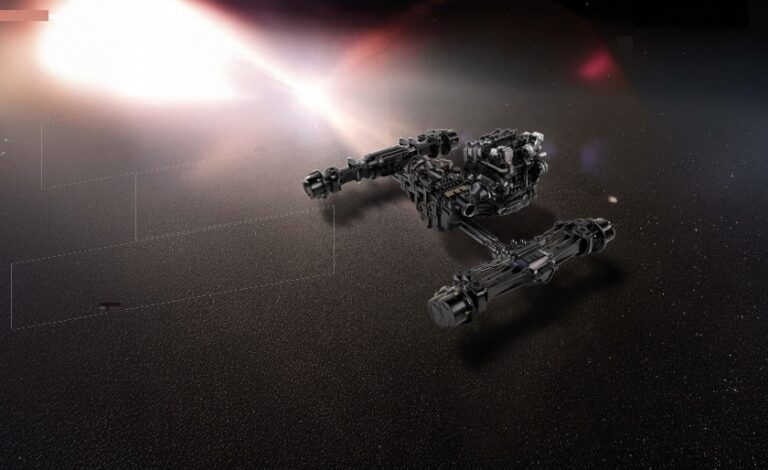
The two hydrostatic motors with variable displacement axial piston pumps are supplied with oil by an electronically controlled load-sensing hydraulic pump driven directly from the engine. At low work speeds, the two motors work together to provide maximum torque – Merlo claims a figure 12% above that of conventional hydrostatic transmissions.
During road work and transport, the second hydrostatic motor is automatically disengaged from the control system and the oil from the pump powers the main hydrostatic motor that drives the machine to maximum speed.
Working together, the two motors deliver maximum possible torque in both yard and field speed ranges. For the latter, the second hydraulic motor is automatically disengaged by the electronic control unit, with no torque interruption. The oil flow that was serving it is redirected to the main hydraulic motor, to help drive the handler to its full possible road speed of up to 50 km/h. In combination with Merlo’s Eco Power Drive technology, which monitors and manages engine revolutions per minute in relation to the requested forward speed and the torque required to attain it, this offers potential fuel savings of up to 3 litres/hr.
Manitou technology
French OEM Manitou offers two different hydrostatic transmissions, and they’re quite distinct from both JCB’s and Merlo’s approaches. Both were launched in 2016. The more basic offering is for smaller machines and is a basic two-range hydrostatic system. The choice of which one to use is down to the operator, who can manually select between the ranges using buttons on the JSM joystick
Low range is 0-18 km/h for maximum torque (high-torque work), while high range is 0-40 km/h for higher speed (transport). The system only requires a single hydraulic pump and motor combination.
For agricultural users performing high amounts of roadwork with larger NewAg models there is a full continuously variable transmission, the M-Vario Plus, supplied by Dana, Bosch-Rexroth. This is a single-range hydrostatic CVT, operating for 0-40 km/h, using dual hydraulic motors, similar in concept to Merlo’s twin pump system.
At low speeds, both radial motors run for maximum torque. For high-speed travel and transport where torque demand is lower, one motor is disengaged resulting in overall lower fuel consumption and noise levels for the vehicle.
Other approaches
While JCB, Merlo and Manitou have taken distinct paths to CVT technology, other manufacturers have developed their own solutions – each with unique characteristics.
German manufacturer Kramer’s Ecospeed transmission incorporates an intelligent engine speed reduction system branded as smart driving. Rather than using dual motors or switching between drive modes, this system monitors driving conditions and automatically adjusts engine rpm to match actual requirements. At maximum travel speed of 40km/h, smart driving can reduce engine speed to just 1,550rpm, cutting fuel consumption and noise while reducing component stress.
The system works across three speed ranges –0-7km/h, 0-15km/h and 0-40km/h –which are electronic restrictions rather than actual gears. For higher-capacity models, Kramer offers EcospeedPro, which uses a 39% larger displacement motor (370cm³) to deliver 10% more thrust and tractive force while retaining the smart driving benefits.
The VariPower 2 transmission fitted to Claas Scorpion telehandlers (manufactured by Liebherr) takes a mechanically distinct approach: two hydrostatic motors share not just a common housing, but also a common shaft and swash plate. Both motors have a maximum swivel range of 23 degrees and are controlled by a single distribution unit.
The key innovation lies in how the system manages oil flow. A powerful Venturi tube continuously extracts oil from the drive housing, significantly reducing churning losses during high-speed travel – a problem that plagues many hydrostatic systems at road speeds. The compact design eliminates the need for transfer gears, improving wear tolerance and service life.
Unlike automatic systems, operators manually select from three speed ranges (0-15km/h, 0-30km/h, 0-40km/h) via the joystick. For applications demanding even more grunt, a VariPower 3 version is available on larger Scorpion models, using a bigger dual motor arrangement to provide 68kN of tractive force – 20% more than the standard VariPower 2’s 57kN.
Bobcat’s V-Drive transmission, also sold as Dyna-CT on AGCO’s Massey Ferguson telehandlers, uses dual hydraulic motors but in a series arrangement rather than the parallel configuration common to other systems. This eliminates the need for a conventional gearbox entirely. Two virtual speed ranges– Turtle (0-20km/h) and Rabbit (0-40km/h) –are selectable via the joystick, with both ranges optimised for their specific applications. A notable engineering focus has been noise reduction: the hydraulic motor is suspended on four rubber mounts, reducing vibrations by 60% and eliminating the transmission whistle that characterises many hydrostatic systems. See page 32 for the more on Bobcat V-Drive.
Notably, CNH’s Case IH Farmlift and New Holland TH ranges buck the CVT trend entirely, sticking with a conventional 6-speed powershift transmission controlled by a 280mm torque converter. The system offers manual operation, a semi-automatic mode (gears 2-4 for shuttling and loading), and fully automatic operation (gears 2-6 for road travel up to 40km/h). Wet multi-disc clutches provide smooth gear transitions, and CNH maintains this technology delivers responsive performance for the majority of agricultural applications without the complexity or cost of a CVT system.
New transmissions received
The convergence of these technologies between 2015 and 2016 was no coincidence – manufacturers were responding to the same market demand for telehandlers that could handle both intensive yard work and sustained road travel.
Yet while the goal was universal, the engineering solutions have been remarkably diverse. JCB chose to physically switch between two transmission types; Merlo and Manitou evolved pure hydrostatic systems to CVT-level performance; Claas and Liebherr focused on mechanical efficiency through innovative oil management; Kramer prioritised intelligent engine-speed control; while CNH continues to argue that a well-executed powershift remains fit for purpose. Each approach reflects different priorities around cost, complexity, performance and manufacturing capability.
For buyers, this proliferation of CVT and CVT-adjacent technologies means the transmission choice is no longer a binary compromise. The question has shifted from “powershift or hydrostatic?” to understanding which flavour of continuously variable transmission – or transmission management – best suits specific operational patterns.
With most manufacturers now offering multiple transmission options across their ranges, customers can match the technology to the task rather than accepting the limitations of a one-size-fits-all approach.
HOW DOES IT WORK? #1
Powershift transmission
JCB’s DualTech transmission uses both powershift and hydrostatic elements. Powershift is essentially an automated manual gearbox. It still has physical gears like a car’s manual transmission, but automatic hydraulic clutches do all the shifting work.
Inside you have multiple gear sets and clutch packs bathed in oil. When you need to change gear, one clutch releases while another engages – and this happens so smoothly that power keeps flowing to the wheels throughout the shift. It’s like having multiple clutches working in relay. The powershift name comes from this ability to shift gears without interrupting power delivery, which is crucial when you’re pulling a heavy load or working on a slope. It is generally more fuel-efficient, especially at higher speeds, because it’s mechanically transmitting power.
HOW DOES IT WORK? #2
Hydrostatic transmission
Merlo’s CVTronic transmission is fully hydrostatic. Hydrostatic transmission has no gears at all. Instead, it uses hydraulic fluid under pressure to transmit power. The engine drives a hydraulic pump that pushes oil through lines to a hydraulic motor, which then drives the wheels or tracks. By varying the angle of a swashplate in the pump (or motor), you control how much fluid flows and in which direction.
This gives you infinitely variable speed control – it’s a continuously variable transmission (CVT) using hydraulics instead of belts. Hydrostatic loses some energy converting mechanical power to hydraulic pressure and back, but gives you far superior low-speed control and manoeuvrability, so ideal for excavators, compact loaders, and telehandlers that need delicate positioning.
HOW DOES IT WORK? #3
Hydro-mechanical transmissions
Hydro-mechanical transmissions are now commonplace in high-horsepower agricultural tractors, delivering continuously split engine power between two parallel paths. The mechanical path uses traditional gears for efficient power transmission, while the hydrostatic path uses a hydraulic pump and motor as an infinitely variable ‘trimmer.’
Planetary gear sets mechanically combine these two power streams, allowing stepless speed changes while maintaining high efficiency. Unlike the telehandler transmissions that switch between systems, true hydro-mechanical designs like John Deere’s AutoPowr and Fendt’s Vario blend both paths continuously. This technology dominates the tractor market but has proven too complex and expensive for telehandler applications, where simpler solutions prevail.
This article first appeared in the January/February issue of iVT