

JCB has unveiled a cluster of hydrogen-focused products at its Staffordshire headquarters, marking a shift from prototype demonstration to full commercial availability for its 3CX Hydrogen backhoe loader, prevsiously only seen s a prototype.
Doubling down on hydrogen, JCB also launched hydrogen-powered generator set, a mobile refuelling system developed with infrastructure partner Hykit, and the announcement of a land speed record attempt using a hydrogen car powered by JCB’s own engines.
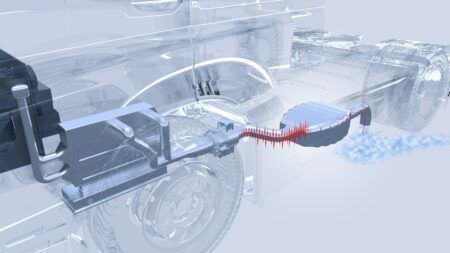
The announcements represent the culmination of more than five years of development and a £100 million investment in hydrogen combustion engine technology. Using a combustion-based approach rather than fuel cell has practical implications for operators: machines run and service in ways closely familiar to their diesel counterparts, with no rare earth elements required in the drivetrain.
3CX Hydrogen: from prototype to production
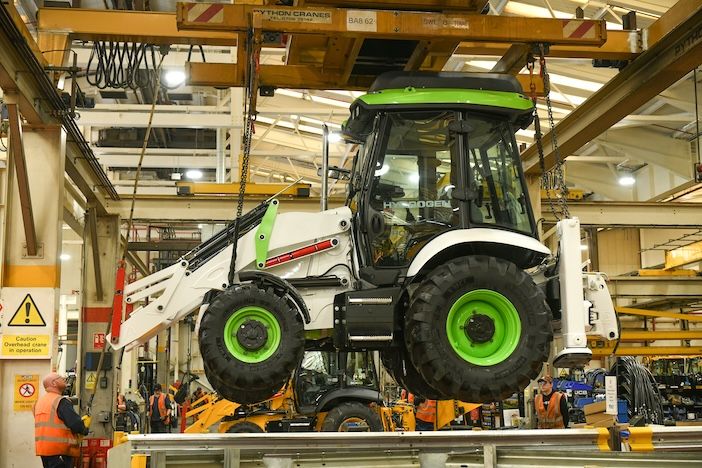
The headline product for off-highway professionals is the 3CX Sitemaster Hydrogen, the world’s first production backhoe loader to use a fully approved hydrogen combustion engine. JCB has been running prototype versions of the machine with customers for several years; this launch confirms it as a commercial product available now.
Power output from the 55kW JCB 448 ABH2 engine matches the diesel equivalent, and customers who trialled the machine during development reported no discernible difference in handling. “The site here and the application that the backhoe is performing is typical of backhoe use,” said one national contractor involved in trials. “Our operator said that it feels the same as the diesel backhoe. He really couldn’t tell the difference.”
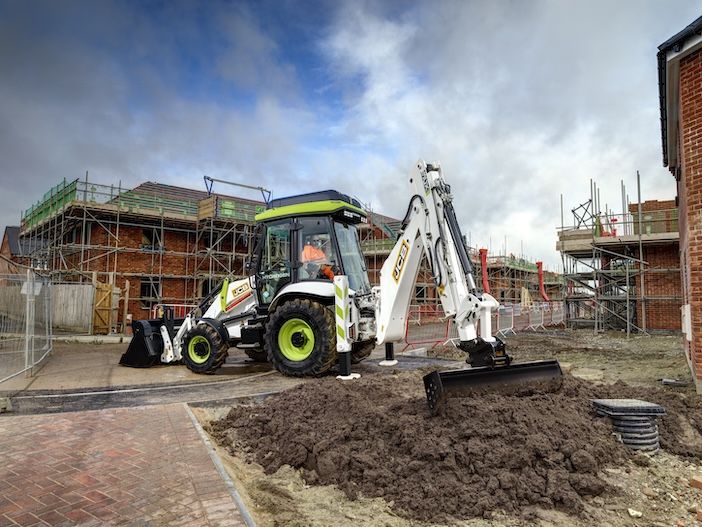
Three composite-wrapped hydrogen tanks are mounted on the cab roof, pressurised to 350 bar and reinforced with Kevlar, providing sufficient capacity for a full day’s operation. Refuelling takes between 10 and 15 minutes. JCB Finance will offer a three-year operating lease and service contract in the UK, with equivalent arrangements through global finance partners.
Lord Bamford, JCB chairman, says: “The unique combustion properties of hydrogen enable the hydrogen engine to deliver the same power, the same torque, and the same efficiency that powers JCB machines today, but in a zero-carbon way. Combustion technology is already well proven on construction and agricultural equipment. It is a technology which is cost effective, robust, reliable and well known throughout not just the construction and agricultural industry, but the whole world.”
Mobile refuelling and hydrogen generation
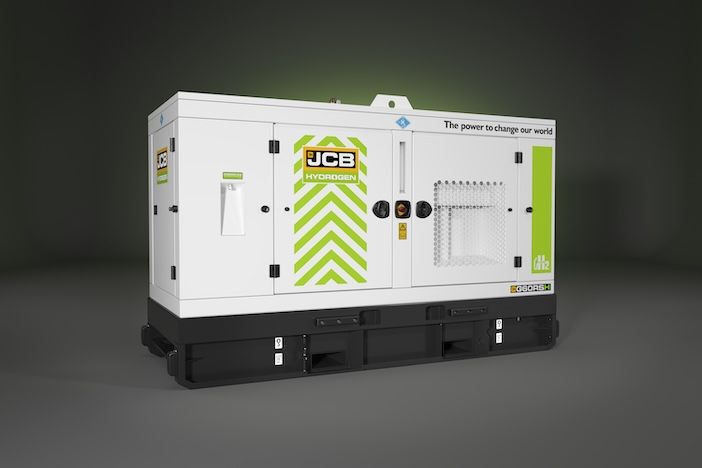
Alongside the backhoe, JCB launched the G60RS H, a 58kVA hydrogen-powered generator set aimed at hire and rental businesses providing off-grid power for construction and events. The unit meets EU Stage V emissions standards without aftertreatment filters or additives, and can be integrated with JCB’s 3-phase Powerpack to form a site microgrid. The first units have been delivered to rental provider Dawsongroup energy solutions.
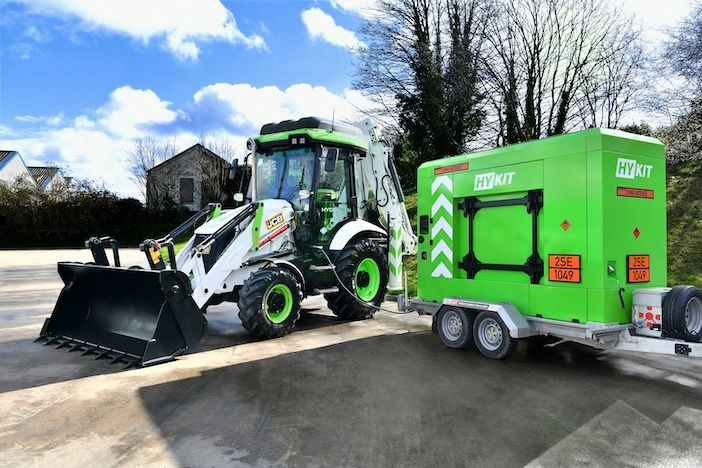
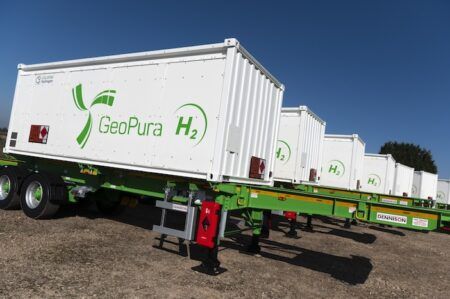
On-site refuelling is handled through the Hykit MHR-X75, a trailer-mounted mobile hydrogen refueller developed by Hykit, a joint venture between JCB, investment company Hycap and clean energy group HydraB. The unit carries 75kg of hydrogen, supports up to seven vehicles at a time, and connects via touchscreen controls with cloud diagnostics and integrated leak detection. It is certified to TPED, ADR and UK CDG standards.
“Hydrogen adoption isn’t being held back by technology, it’s being held back by infrastructure,” says Dr John Vickers, Hykit’s director of engineering. “With our MHR-X75, we’re removing that barrier by enabling customers to deploy hydrogen refuelling exactly where their equipment is working, without needing a fixed supply.”
Land speed record attempt
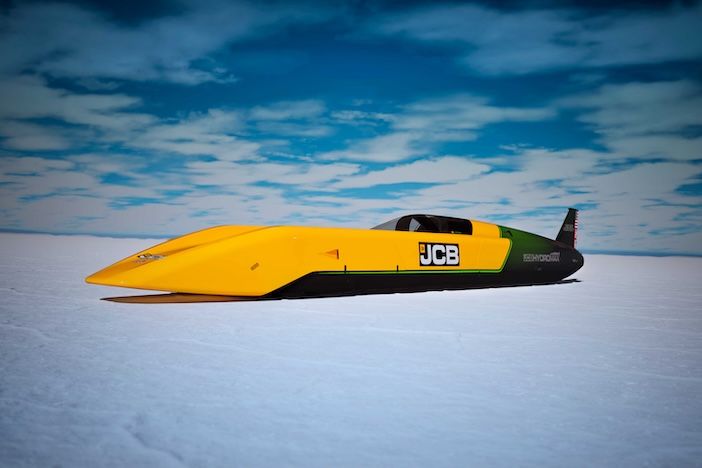
JCB also announced it will attempt a hydrogen land speed record at the Bonneville Salt Flats in Utah this August, exactly 20 years after its JCB Dieselmax car set a diesel land speed record of 350.092mph that still stands. The new challenger, JCB Hydromax, is a 32-foot vehicle producing 1,600bhp from two production-based hydrogen engines. Wing Commander Andy Green OBE, who drove the Dieselmax in 2006 and holds the overall land speed record of 763.035mph, will again take the wheel. The project is supported by Prodrive and Ricardo.
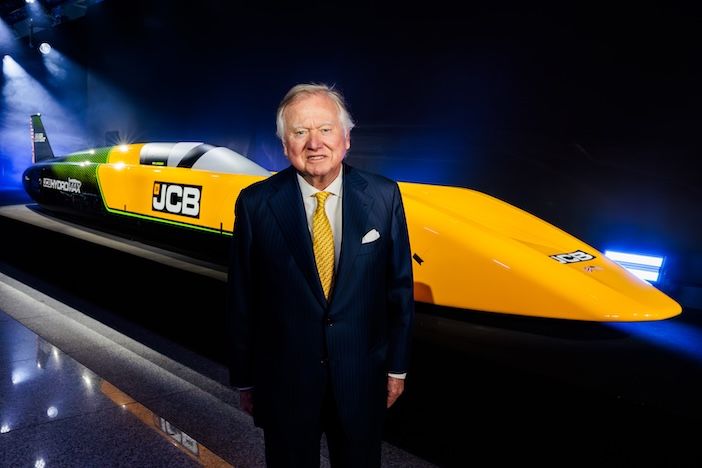
“Twenty years ago, JCB took two of its diesel engines, sprinkled some magic engineering dust on them and put them into a racing car,” says Green. “Now we’re going back to the Bonneville Salt Flats with JCB’s new hydrogen engines. The JCB Hydromax car is lighter, more powerful and faster than its predecessor of 20 years ago.”
Lord Bamford adds: “This is not just about speed – it’s about showcasing the world-class engineering talent we have here in the UK and the robustness of our new hydrogen engines.”
The speed attempt is timed to coincide with the opening of JCB’s new $500 million factory in San Antonio, Texas, a one-million sq ft facility on a 400-acre site that will employ 1,500 people manufacturing machines for the US market.