


Correct PTO specification links torque demand, transmission interface, engagement behaviour and lubrication strategy to real machine duty cycles, worst-case conditions and hydraulic loads
PTO selection should begin with the machine duty cycle and load profile. OEM engineers should evaluate torque rise from the engine or transmission, start-up inertia of the driven load, and acceptable engagement timing. High-inertia loads may require controlled engagement to reduce shock. Applications with frequent cycling or sustained operation should be reviewed for torsional vibration, duty-cycle heat buildup, and lubrication margin.
Specification should also account for side loading or overhung moments at the output shaft, driveline alignment, gear ratio selection, and pump mounting constraints. The transmission interface has defined limits for torque, speed, bending load, and mounting position; these should be confirmed before package release. Overspeed protection, NVH behavior, service access, and validation under real machine duty cycles are as important as nominal horsepower calculations.
OEM engineers should define the required torque and speed, along with the continuous and intermittent load conditions. They should establish the engagement frequency and the allowable start-up shock. The transmission interface requirements must be defined, as should the pump inertia and coupling characteristics. Finally, engineers should account for the available mounting space and service clearance.
Configuration and engagement choices
PTO configurations support different transmission layouts, torque ranges, mounting positions, and packaging constraints. Selection should account for shaft orientation, pump location, clearance to frame rails or exhaust components, driveline angles, lubrication access, and installation repeatability on the production line.
Engagement options include mechanical shift, air shift, powershift, and constant-mesh designs. Mechanical and air-shift options may suit simpler operator-controlled systems. Powershift and constant-mesh designs can support applications requiring more consistent engagement behavior or integration with automated controls. Engineers should consider whether engagement occurs at rest, at idle, or during controlled operating conditions.
Engineering factors that drive PTO life
Key specification inputs include the torque demand and speed, the duty cycle and operating hours, and the transmission architecture. They also include the mounting location and packaging, the gear ratio selection, and the shaft loading and alignment. Coupling selection, lubrication strategy, and hydraulic pump requirements are further inputs, as is the controls and interlock strategy.
Common failure modes include spline wear, bearing distress, gear tooth damage, seal leakage, overheating, and premature coupling wear. These issues are often related to misalignment, excessive overhung load, inadequate lubrication, shock loading, or operation outside the intended speed range.
Engineers should evaluate transient conditions such as torque spikes, overspeed events, thermal buildup, NVH, and shock loading. Validation should include the expected duty cycle, worst-case engagement conditions, cold-start behavior, sustained operation, and representative hydraulic loads.
Parker Chelsea engineering-relevant capabilities
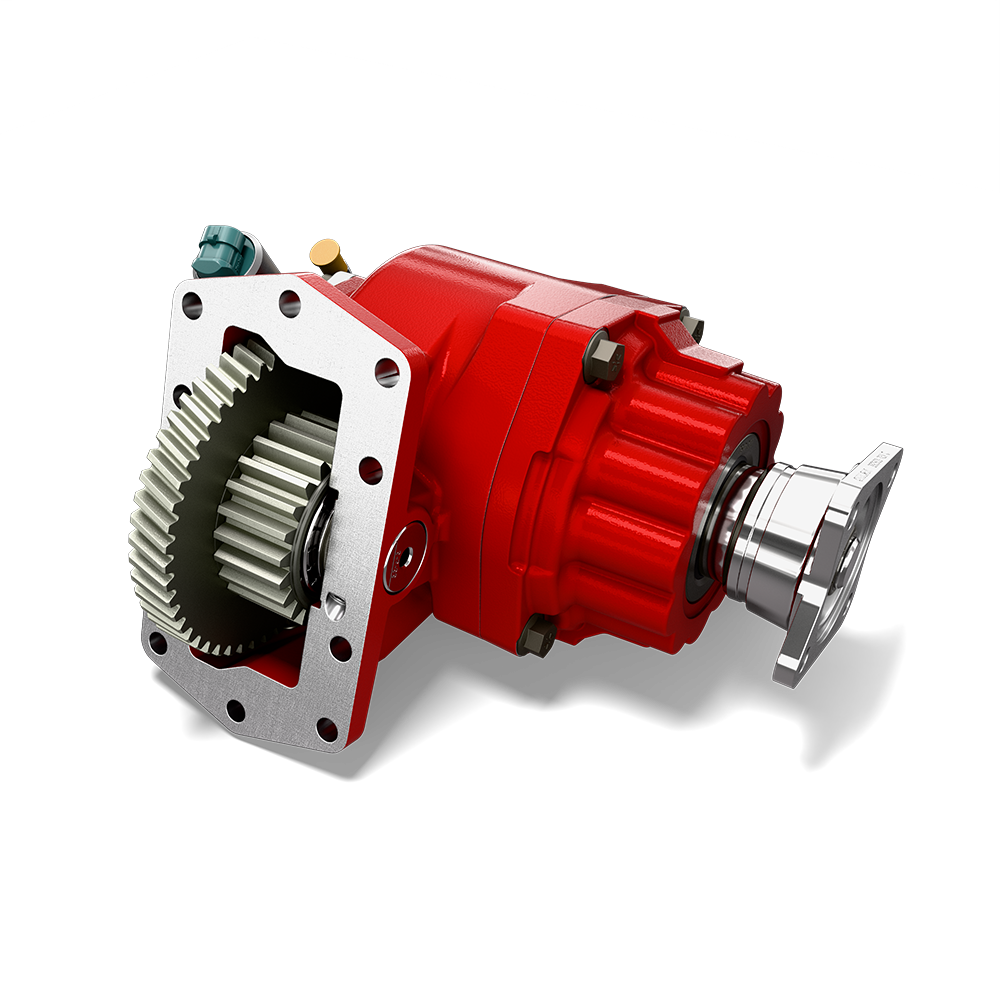
Parker Chelsea’s PTOs include design features intended to support integration and durability in mobile equipment. These include cast iron housings for structural rigidity and tapered cone bearings for shaft support. Precision gearsets provide load transfer and NVH control, while Wet Spline lubrication reduces spline wear. Smart Start pressure modulation helps manage engagement shock, and multiple configurations support transmission and flexibility.
These capabilities are useful when considered early in the design process, especially where pump inertia, high cycling rates, or limited packaging space increase drivetrain stress.
Lifecycle and ePTO considerations
Vocational platforms are increasingly evaluating electrified auxiliary power and ePTO architectures. Mechanical PTOs remain central to many hydraulic work functions, but future equipment will combine mechanical, hydraulic, and electric auxiliary power such as Parker’s new e400 Adaptive ePTO.
The OEM decision should be based on duty cycle, efficiency targets, service model, thermal limits, controls integration, packaging, and lifecycle cost. A well-specified PTO supports machine uptime by aligning auxiliary power demand with the drivetrain, hydraulic system, operator interface, and service requirements.
For more information about Parker Chelsea’s PTOs, visit https://discover.parker.com/PTO