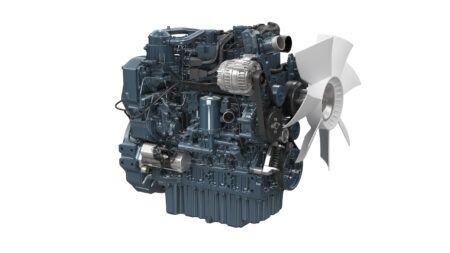



Running an engine on hydrogen is the easy part, says Todd Anderson, PHINIA vice president and chief technology officer. Making it reliable and efficient enough for heavy off-highway work requires rethinking fuel injection, materials and ignition to cope with hydrogen’s low energy density, tendency to embrittle metals and high flame speed
In the off-highway industry, the energy transition has never been simply about choosing a new power source. A machine working continuously on a construction site, in a quarry or in agriculture must deliver performance, durability and uptime in conditions that can be far removed from those experienced by a passenger or on-highway vehicle.
Hydrogen internal combustion engines (H2ICE) offer one potential route forward, building on proven combustion-engine architectures while providing a pathway towards lower-carbon operation. But demonstrating that an engine can run on hydrogen is only part of the challenge. Commercial deployment requires it to perform reliably, efficiently and economically across demanding off-highway duty cycles. That challenge starts with the fuel system, where hydrogen’s physical properties create different requirements for fuel delivery, materials and injection strategy.
Engineering the fuel system
Hydrogen’s low volumetric energy density means an injector must deliver substantially greater volumetric flow than with a conventional liquid fuel, while still fitting within constrained engine packaging. Gaseous-fuel injection therefore requires different specific characteristics related to injector flow capacity and design.
On-vehicle storage pressure has advantageous aspects for fuel system design. Hydrogen is carried onboard at high pressure, creating an opportunity to use that pressure directly to drive injection rather than adding a separate gas-compression system. This places greater demands on fuel-metering components but can reduce system complexity, an important consideration where packaging and cost are constrained.
Hydrogen also changes the material requirements of the system. It can cause embrittlement in susceptible metals, while its properties make preventing leakage particularly challenging. Materials, interfaces and sealing strategies therefore need to be engineered specifically for the fuel and the system’s operating temperature and pressure ranges.
Injection strategy presents another design trade-off. Port fuel injection offers a relatively straightforward route to introducing hydrogen, but gaseous fuel introduced upstream can displace air that would otherwise enter the cylinder. Direct injection introduces fuel after the intake valve has closed, preserving more of the cylinder’s air charge and creating greater scope to optimise mixture formation and power density. For off-highway engines operating under sustained high loads, these differences can directly influence performance and system design.
Managing hydrogen combustion
Fuel delivery is only one part of the challenge. Once hydrogen enters the cylinder, its combustion characteristics require equally precise control. Compared with methane, hydrogen requires much less energy to ignite and has a higher flame speed. Ignition timing and calibration therefore become critical to controlling combustion across changing engine speeds, loads and operating conditions.
Calibration must also balance combustion performance with component durability, including spark-plug life. In off-highway applications, where equipment may operate for long duty cycles and downtime is costly, component life and maintenance intervals directly affect total cost of ownership.
Recent testing by PHINIA provides an indication of the efficiency achievable when fuel delivery, ignition and combustion control are developed as an integrated system. A 13-litre commercial-vehicle development engine, converted from diesel to hydrogen, has demonstrated indicated thermal efficiency above 45%. The underlying challenges of fuel delivery, combustion control and durability are also relevant to heavy-duty off-highway applications.
The engineering challenge becomes broader when the same principles are considered across other gaseous fuels. Hydrogen, methane and ammonia have markedly different ignition and combustion characteristics, so a strategy developed for one cannot simply be transferred to another. A flexible ignition and control architecture can accommodate these differences while allowing engineering approaches and, where appropriate, components to be shared across fuels.
For off-highway OEMs, this flexibility matters because fuel availability, infrastructure, regulations and duty cycles will vary by market and application. Engineering combustion systems to accommodate those differences can enable manufacturers to apply different gaseous fuels while retaining the performance, durability and uptime demanded by off-highway equipment. H2ICE technology has advanced strongly in the past couple years and PHINIA has demonstrated excellent performance characteristics of these systems in challenging real-world conditions. This illustrates technology readiness and feasibility for this solution to be part of the path forward – driving toward a cleaner tomorrow.