

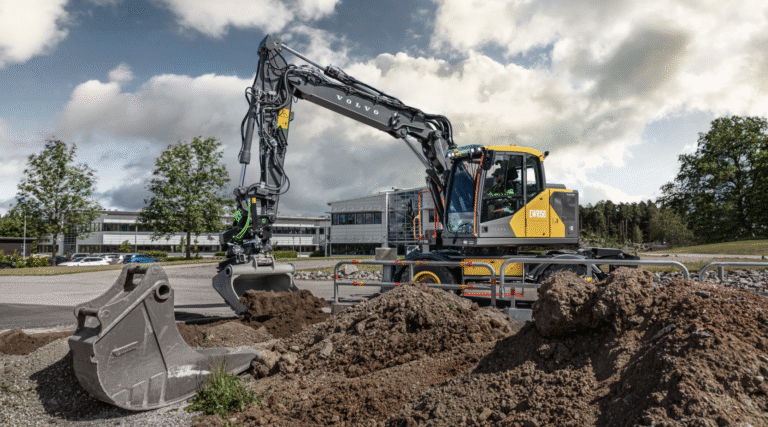
Volvo construction equipment’s first fully electric wheeled excavator packs a redesigned hydraulic system, electric travel motor and high- voltage architecture into the same envelope as its diesel equivalent – a component-integration challenge that reveals the OEM’s current approach electrification across its range
Urban construction sites are under growing pressure. Tightening emissions regulations, noise restrictions and rising expectations around sustainability are reshaping what the market asks of its machines. Volvo Construction Equipment’s (CE) response is the EWR150 Electric – its first fully electric wheeled excavator and the latest addition to a rapidly expanding zero-emission portfolio.
“We are not betting on one horse,” says Fredrik Tjernström, electromobility solutions sales manager, Volvo CE. “We need to explore all available technologies: battery electric, hydrogen fuel cell, combustion engines running on alternative fuels. But the most mature and most cost-effective technology today is battery electric.”
The 15–17-tonne machine travels independently on public roads without a transport trailer, removing the logistical burden of moving a wheeled excavator between sites. Zero tailpipe emissions and near-silent operation suit the urban environments where wheeled excavators are most in demand such as city centres, utility corridors, road projects and confined residential sites. Why begin wheeled excavator electrification with this model rather than a larger or more specialised platform? “This is the most requested machine,” explains Henning Bäumchen, product specialist at Volvo CE. “It works in the city and urban construction. It’s the most versatile machine we have and, of course, the highest volume, so we started with this one.”
Engineering for efficiency
Translating a proven diesel platform into a fully electric machine presented an immediate constraint. “The biggest challenge is to fit all the components, such as the batteries and electric motors, in the same dimensions as the diesel EWR150 while still delivering a full day’s runtime,” says Bäumchen.
Rather than chase that power autonomy through everlarger battery packs, Bäumchen says the development team prioritised energy efficiency across the whole machine. “The hydraulic system has been completely redesigned to recover power during boom-down and swing movements that would otherwise be lost as heat, and an electric travel motor replaced the hydraulic drive used on conventional machines. This comes to a much lower energy consumption and the machine can fully operate for around 8–12 hours.”
Integrating the high-voltage system demanded changes beyond the driveline. The steel structure was reworked to carry the new components, while electric safety, insulation, fault detection and high-voltage management, absorbed a substantial share of the development programme. Temperature control proved equally demanding, with the battery pack and the high-voltage cabinet each requiring their own regulated thermal circuit. “The batteries always love to be around 25°C,” Bäumchen says. “We need to cool them down, heat them up, depending on the ambient temperature, and the cabinet needs the same. It’s a challenge to have all these systems implemented.”

Performance and operator experience
Matching the diesel machine was a fixed requirement of the programme. Lifting capacity, digging forces and machine speeds carry over unchanged, and on travel the electric driveline edges ahead. “Maybe when you travel you have a slightly better acceleration, due to the characteristics of the electric motors,” says Bäumchen. “The rest is the same.”
That responsiveness is consistent across the wider electric range. “The electric motor response is more immediate, you don’t have to rev up a diesel engine and then build hydraulic pressure,” says Tjernström. “And because there are more software-controlled systems, we can fine-tune more, so the operability is improved. The actual torques and hydraulic pressures are one to one with the diesel machine.”
Behind that consistency lies a shared electric architecture. The battery is manufactured by Volvo, and the EWR150 Electric runs the same e-drive system as the L90 Electric wheel loader and EC230 Electric crawler excavator, with each model differentiated by the number of battery packs fitted. For an OEM, the appeal is obvious – common hardware and software spreads development cost and complexity across multiple machines rather than concentrating it in one. Tjernström sees this as one of the group’s clearest structural advantages. “There is strong synergy at group level, firstly between Volvo Trucks and Volvo CE, and secondly within Volvo CE. It is not only the batteries, but other components such as power electronics, cooling fans and DC-DC converters. If machines have similar power needs, they can share the same system, allowing us to use much of the same technology and software across CE.”

Inside the cab, a console-mounted 12in touchscreen moves with the seat to keep the interface stable whether the machine is working on a level site or travelling over rough ground. Storage has grown, with dedicated spaces for personal items including a shoechanging area for operators who switch footwear between the cab and the ground. A wireless phone charging point and revised joysticks round out an environment built for a full shift in the seat.
The absence of engine noise changes how the machine is worked. “You can now operate with the door open and talk to your colleagues working around you,” says Bäumchen. “Normally you’d need a headset or have to stop working.” For suppliers and OEMs targeting urban fleets, near-silent operation also unlocks restricted working windows that diesel machines cannot access, as cities continue to tighten noise limits.
Charging on site
A 22kW onboard AC charger comes as standard, recharging the machine from a 400V supply overnight, while DC fast charging at up to 150kW handles applications needing a quicker turnaround. The machine uses the industry-standard CCS connector, a choice Tjernström frames as central to making the technology easy to adopt. “Our machines have the CCS charging interface which is the same as you have on your car, a truck or a bus so you can easily share the charging infrastructure between several types of equipment. That’s what we want, because it should be easy to implement these solutions.”
Low power demand keeps the machine within reach of an early-stage site, too. “The machine charges from the temporary supply present on most building sites,” says Bäumchen.
A single machine is easy to plan around. Fleets and mixed sites are more complex.“We have the tools to simulate fleets of electric machines, or a mixed fleet with diesel and electric to understand which machine capacity you need, whether you can keep productivity up, and calculate how many chargers you need and where to install them,” says Tjernström.
A tipping point
Early electric machines in markets such as Norway were costly local rebuilds; what Volvo CE now offers is something different in kind. “All our solutions today are factory-built, serially produced in the equivalent factory to the diesel model,” says Tjernström. “We can mass-produce at a much lower cost now.”
Beyond regulatory compliance, the commercial logic for electric equipment is shifting, and Tjernström argues the industry has reached an inflection point. “We see so many cases now where customers can eliminate CO2 and NOx emissions and at the same time save money. That’s really exciting, we see that we’ve come to a tipping point.”
The EWR150 Electric is both a product and a proof of method: a serially produced machine that shows how a high-volume diesel platform can be re-engineered for electric power without surrendering dimensions or performance.
This article first appeared in the July/August issue of iVT