

Jungheinrich has extended its product portfolio of automated robots with the EAC 212a featuring ai-based load detection and a safety architecture that the OEM says owes nothing to shortcuts
High-lift handling is one of the hardest jobs to hand to an autonomous mobile robot, where a misread pallet several feet up can stall an entire process. Jungheinrich saw a gap in its own portfolio and in the wider market, and it is positioning a new machine to close both at once.
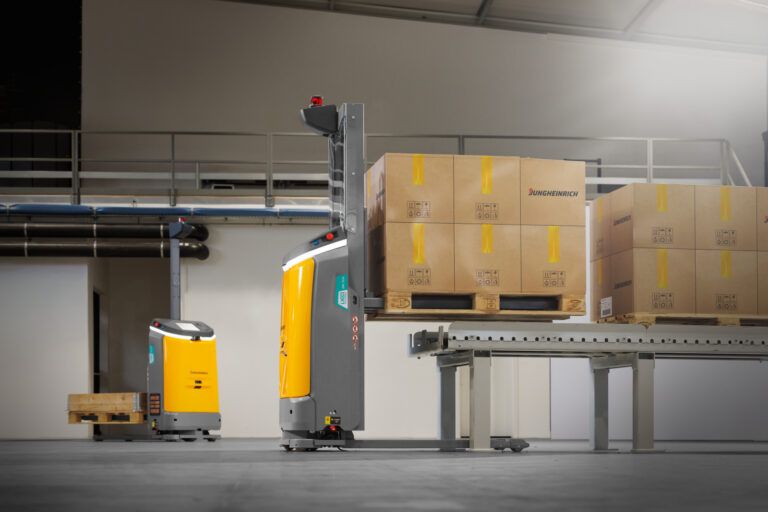
The EAC 212a, unveiled in February and scheduled for market launch in the second half of 2026, handles pallets and stillages at floor storage locations, conveyor systems and buffer lanes, with integration into automated storage and retrieval systems also possible. It carries up to 1,200kg to a transfer height of 1,200mm and travels at up to 6km/h.
“There’s a gap in the Jungheinrich portfolio, but there’s also a gap in the market at the same time, so it’s great that they’re aligned,” says Jonas Radtke-Payne, product manager, Jungheinrich. “The EAC is really then the workhorse of logistics and industrial automation. It manages floor-based pickups, put-downs, lanes and block storage, and delivers goods to conveyor systems, manufacturing cells, palletisers and stretch wrappers.”
No shortcuts on safety
Mobile robots are now compressing into a couple of years the safety evolution that robot arms underwent across three decades, with standards revised every year or two, and the market demanding ever more handling of unsafe situations and corner cases.
“We are proud to say that we don’t take shortcuts here,” says Radtke-Payne. “We’ve made things deliberately hard for ourselves by really trying to catch any corner case here. We even evaluate the safety of our competitor’s robots and sometimes we find things where our safety experts say, ‘If there was a real situation, I really wouldn’t have liked to be the person standing next to that robot in that moment.’”
A 360-degree safety sensor system continuously monitors the surroundings, detecting and avoiding unexpected obstacles in the direction of travel from a height of just 70mm.
Seeing the pallet clearly
In high-lift work, the quality of load handling sets the standard for system stability. The EAC 212a uses AI-based 3D pallet detection that compensates for positional offsets of around 100mm and torsion of around 10 degrees, so it keeps working even when pallets are placed manually and in the wrong place.
Navigation is contour-based, with lidar sensors building a map of the existing environment so the vehicle can move independently. No artificial landmarks or structural changes to the warehouse are required, which shortens lead times and allows layouts to be reworked at the operator’s convenience.
Setting up that environment is, by Radtke-Payne’s account, almost a drawing exercise with mapping a site being only a matter of minutes. The operator drives the robot around the warehouse to record the map, defines a working area, then places and connects ground stacking locations, lanes, conveyor stations and chargers on a graph. The system validates as it goes, flagging out missing or incorrect information and problematic situations, for example a turning radius that is too tight or a charger missing a serial number before anything is committed.

“Once you have mapped everything accordingly, defined your sinks and sources, as well as traffic rules, you hit save. After validation is run, this setup is automatically transferred to each robot. You hit play and it is transferred to the robots. The robots automatically start using this new layout and you’re done. Changes can be made by the operator at any point through the same process. The days when setting up a robotic system was a high-tech endeavour are over.”
Radtke-Payne highlights how the robot also operates with a degree of autonomy within those defined areas – it is not constrained to follow the drawn path exactly. “When someone has parked a manual truck or is standing in the robots path while having a coffee, the robot will go around it. The degrees of freedom within which it can deviate are configured at setup.”
Flexible charging
The EAC 212a runs a fully integrated 130Ah lithiumion battery and an automatic opportunity charging concept, travelling to the charger during gaps between jobs and topping up rather than waiting for a full cycle. A full charge takes roughly an hour with runtime around six hours.

The concept is configured per deployment rather than left to run itself, with thresholds set for when a robot can charge, when it must, and for a minimum charge duration. “It isn’t as simple as saying the system just does it all by itself,” says Radtke-Payne. “We have an in-depth look for each project at what is the charging concept that works best for that particular application, and we configure it accordingly together with the customer. If you know that there are certain high-load periods, this can be factored in so that the robots are ready and can actually handle those peak transport volumes.”
When humans step in
The robot carries a large HMI screen built for operator intervention at the machine itself. “When something goes wrong, you don’t need an expert,” says Radtke-Payne. “The robot tells you exactly on the screen what’s wrong, what it was expecting and what you should do. It gives you a range of different solutions.”
When a barcode is missing or a pallet is positioned incorrectly, the operator selects from the options: retry, finish the job manually using the onboard remote or divert the pallet to a clearing station. The robot then continues autonomously.
That flexibility is also where Radtke-Payne draws the line between automated mobile robots (AMRs) and automated guided vehicles (AGVs). “The AGV has problems in terms of flexibility. If someone left a cleaning cart standing and wasn’t aware it was on a robot path, your entire warehouse will potentially stand still, whereas the AMR will just drive around it.”
The trade-off, he says, is that the autonomous behaviour of an AMR is harder to plan to the second. “You really have to look at what you are after and Jungheinrich will recommend whichever fits.”
What comes next?
Designed as a scalable solution, the EAC 212a receives new functions and use cases through over-the-air updates as they are developed. The longer-term roadmap, however, reaches into both software and hardware.
On the software side, Jungheinrich is evaluating where AI can strengthen its perception-based models. “We are seeing what kind of applications we can find inside our perception-based models to make more use of these algorithms,” says Radtke-Payne.
Sensor technology is the other area under evaluation. Most mobile robots rely on rotating lidar, but solid-state alternatives are attracting attention across the industry – driven largely by development in the automotive self-driving sector. Jungheinrich monitors that work closely, assessing whether sensors developed primarily for autonomous vehicles can be adapted for warehouse robotics.
“There is a question of whether you can get better form factors, fewer moving parts on the robot and better performance,” says Radtke-Payne. “We have quite a large development team, so we can have an ongoing evaluation of technologies. Whenever something new comes out and is trending, we have a look at it, we assess it, and if there’s something that could be a benefit to the customers, it may find its way into the product.”
This article first appeared in the July/August issue of iVT