

As off-highway machines take on more autonomous and semi-autonomous functions; the operator is moving from direct control to supervision. We hear directly from the manufacturers on why that shift makes the interface a central design problem rather than a final layer on detail
Autonomy in the off-highway sector is no longer about whether machines can drive themselves, but about keeping the people around them informed and in control as each function is automated.
That tension framed iVT International’s standing-room-only panel session which took place at iVT Expo in Cologne, titled Autonomous Future? Exploring the Challenges of Machine Control and Driverless Systems for Off-Highway Vehicles. Moderated by iVT International editor, Tom Stone, it brought together Michael Schwall, expert research engineer, Volvo CE, Dr Stefano Fiorati, director of powertrain innovation, CNH Italy, Agni Biswas, autonomous control systems engineer, Danfoss Power Solutions, and Fredrik Wahlström, senior product line manager for onboard computing, Cross Control.
“We’re at the beginning of quite an exciting journey,” said Schwall, pointing to autonomous hauling as the proving ground from which the sector has drawn its earliest lessons. The Volvo CE HX01, a prototype autonomous load carrier, was cited as a case where productivity and safety imperatives could make autonomous deployment viable.
Fiorati broadened the picture to the agricultural sector, where guidance has been established for years but working functions remain the next step. “We are definitely looking at the automation of machine functions in a way that we can start to build the steps towards fully autonomous vehicles,” he said, noting that while tractors with standalone autonomous functions are already available tractor/implement combinations and self-propelled machines operating in the field present their own distinct challenges, each one placing new demands on how the operator monitors and intervenes.
From control to supervision
From the component side, Wahlström made the case for developing dedicated interfaces: “Often you forget that even if it’s autonomous, you need to interact with it somehow, either via radio control or graphical user interface.”
It is a point echoed by suppliers away from the panel discussion. Marie Gladare, communication manager, Scanreco, the parent company of Cross Control, has the view that automation recasts the operator rather than retiring them. “With automation, the HMI becomes a central part of early machine design, no longer an add-on for convenience, but the main link between operator and machine. To work effectively, both need to understand each other. In practice, this means moving away from interfaces that simply present large volumes of data, and instead providing clear, relevant information at the right moment – highlighting deviations, guiding attention and supporting efficient interaction without distraction or overload.”
As machines take on repetitive or precision tasks, operators increasingly monitor system behaviour, validate processes and intervene when required, and some may oversee several units at once. “Operators no longer expect remote controls to only control the machine,” says Gladare. “They need the same reliable, real-time feedback they receive in the cabin to move with them.”
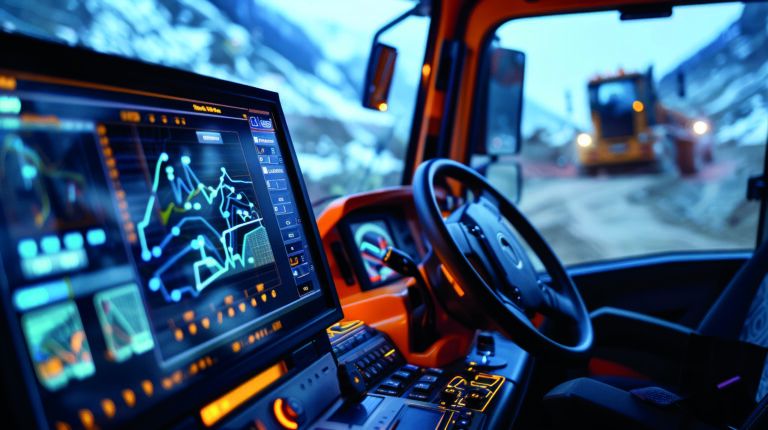
Whether the operator is being designed out at all is where Chris Zellner, senior product manager for displays at Danfoss Power Solutions, comes in. “The goal in many off-highway applications is to automate individual tasks a machine performs, rather than the entire vehicle,” he says. “This means operators remain deeply involved in machine operation, so the need for HMIs is not diminished. Because autonomous and semi-autonomous functions are often initiated and monitored through HMIs, the importance of HMI design has never been greater.”
The best interface shows less
If a machine that handles material is the next engineering frontier, the data it generates is the next interface problem. Logan Ward, director of strategic growth and innovation, NVR, argues that good design now means hiding complexity rather than exposing it. “Modern vehicles generate massive amounts of data from dozens of electronic control units. Displaying every raw value or fault code directly to the terminal increases cognitive load instead of reducing it.”

NVR is integrating edge computing and AI directly into the interface architecture, processing inputs from the controller area network using sensor fusion algorithms and surfacing only what requires immediate attention. The approach is being applied in dynamic weighing systems for earthmoving equipment, where edge-processed models analyse hydraulic pressure and boom geometry data in the background during the dig cycle. “The HMI filters out the complex calculation variables, presenting only a clear, real-time payload metric and low-latency optimisation prompts to the operator,” says Ward.

According to Ward, qualities that once defined a rugged display, surviving extreme temperatures, vibration, water and dust ingress, and bright sunlight, remain essential but no longer differentiate one interface from another. What separates them now is what they choose not to show. The same architecture also segments the data by user without redesigning the hardware: operators get concise guidance, technicians get diagnostic detail, and fleet managers see utilisation trends – each a version of the same data tuned to the decision in front of them.

Minimising what Zellner calls “information noise” is the shared aim. “To help operators focus on the task at hand, the display must offer information quickly and without excessive screen interaction or clutter.” The fix is part software, part hardware: legible, well-timed information on screen, but also larger displays, antiglare coatings and physical buttons for frequently used functions rather than touchscreen-only interfaces. The pressure is compounded by the number of screens in a modern cab, where operators work across multiple displays from the OEM and third-party suppliers at once, making attention management, rather than data availability, the design problem.

Built in, not bolted on
For Andrea Gennari, CEO of U-Control, the lesson is that the interface can no longer be added at the end of development. “It is a system integration challenge. The interface must be developed with software architecture, control logic, hydraulic functions, safety requirements and diagnostic strategies.”
Every assisted function, on this view, adds a new interface decision about what stays under direct control, what can be automated, what must be supervised and how the system requests attention when limits are reached. “Confidence is not created by automation alone,” says Gennari. “It is engineered through system integration: the point where command, feedback, diagnostics, safety logic and machine response become one coherent interface.”

For Mark Wass, DSEControl’s general manager, the payoff of that integration is what reaches the operator. It comes, he says, from “combining robust hardware with advanced integration and real-time insight” to give operators the information they need to work safely and efficiently in increasingly demanding operating conditions.
That systemic view is echoed across the supplier base. “Machine autonomy should not be seen as a single technology,” says Giulio Gaioni, sales & marketing director for Ubiquicom, a Zapi Group Company. “It is the result of connectivity, data analytics, energy management, safety systems and system integration working together.”
Within that connected picture, Gaioni points to operator-facing safety as the clearest case for the interface, where collision-avoidance and proximity systems must translate detected risk into a warning the operator can act on in time.
Biswas made the same point during the iVT International-hosted panel. He framed safety as a problem of operational boundaries, with failures typically occurring not because a single subsystem malfunctions, but because of disconnects between subsystems that were not caught during safety analysis. The interface is where those connections become visible to the person in charge of the machine, or fail to.
The human stays in the loop
Closing the session, Fiorati flagged self-diagnosis as an often-overlooked capability that fully autonomous machines will need. A vehicle operating without an operator must be able to monitor its own functional envelopes and communicate deterioration before it reaches failure, he argued, or it simply stops in the field with no indication of what has gone wrong. Biswas tied this back to the interface question, noting that even a fully autonomous machine will ultimately need some form of user interface to communicate its state.
For all the talk of driverless machines, the through-line from the panel to the wider supplier base is that the human is not being designed out. The operator’s role is shifting from manual control to supervision, exception handling and decision-making, and the interface that supports that role is becoming the place where command, feedback, diagnostics and safety logic are reconciled. “While fully autonomous machines are yet to be deployed at large scale, the human remains in the loop,” says Gladare.
The question for the sector is no longer only how to make machines act on their own, but how to keep the people around them confident that they understand what the machine is doing, and able to step in when it does not.
This article first appeared in the July/August issue of iVT