

The latest iteration of Komatsu’s largest production forwarder pairs a more powerful crane with a completely reworked load space and frame architecture, backed by the company’s first electronically controlled hydraulic pump on a forwarder – technology it plans to rolls out across its entire forwarding range
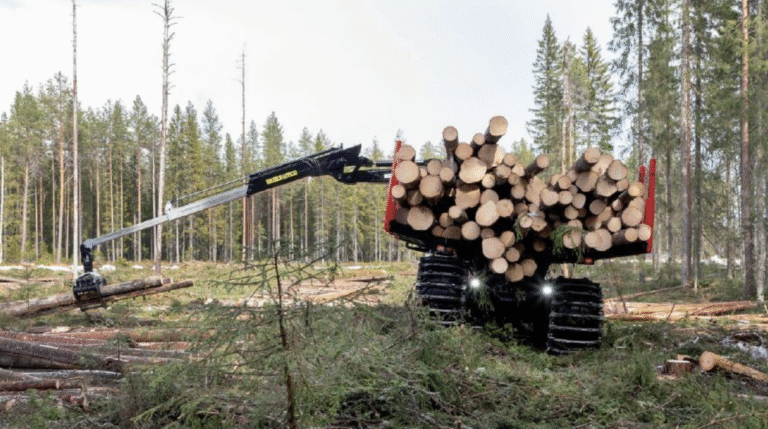
Komatsu Forest’s 895 forwarder has been a mainstay of large-scale final felling and plantation operations since its introduction in 2012. With a 20-tonne load capacity and a strong track record across the Nordic countries, North America and South America, the machine has been one of the company’s bestselling forwarder models by volume. But customer feedback pointed to two clear priorities for the next generation: increased crane capacity and greater durability. The result is the upgraded 895-3, Komatsu’s largest forwarder in production.
A crane built for the task
At the heart of the 895-3 upgrade is the new 205F crane, which replaces the previous 165F unit and delivers substantially higher lifting and slewing performance. It is available with reaches of 7.5, 8.5 and 10 metres, with a single telescopic outer boom at the shorter reaches and a double telescopic boom at the full 10 metre configuration. A stronger GX rotator completes the package.
The choice of crane reach depends on the operation. “Normally, if you’re working in final felling and the plantations, you can manage with a shorter reach,” says Daniel Grabbe, Komatsu Forest product manager. “But depending on operations, you can also have a 10 metre crane if you need more reach.”
Reinforced from frame to load space
The stronger crane naturally placed greater demands on the rest of the machine, requiring Komatsu Forest to rethink the structural architecture from the ground up. “We start with measurements on our machines and what the new higher crane capacity would add to the workload. Then with simulation and calculations to see how much stronger we need to make the frame system, the bank system, the crane and so on. We make the design, and then we make the calculations,” says Grabbe.
Once the design phase is complete, Komatsu Forest manufactures prototype components and subjects them to accelerated lifecycle testing at the company’s dedicated test centre to validate durability before series production.
Designed for versatility
The redesigned load space is where much of the 895-3’s practical improvement is felt by operators. The new telescopic gate can be raised by up to 500mm as the load space fills, meaning the crane does not have to lift as high during initial loading. It can also be moved along the rear frame to accommodate different log lengths and assortment configurations, a useful feature when switching between sawlogs, pulpwood and shorter assortments. The gate is raised and lowered hydraulically, and its foldable wideners can be locked in either the folded or extended position.
“We want to keep the centre of gravity of the loaded logs in the front of the rear axle, to get the good stability”
The load banks — the structural cradles that hold the timber on the machine — have been completely redesigned for increased robustness. They can be equipped with either telescopic or articulated wideners depending on conditions, with the articulated type suited to plantation forestry. Hydraulic height-adjustable stakes are available as an option to further increase productivity. The banks widen for loading during operations and narrow to 3.2 metres for ease for road transport on trucks between sites.
Extended frames
One of the key additions to the 895-3 is a new extra-long rear frame option. In Brazil, Komatsu Forest’s largest market for this product in South America, eucalyptus plantation forestry has shifted towards increasingly long log lengths, now typically 7.2 metres. The previous model’s rear frame options were too short to handle these lengths optimally, necessitating the redesign.

The new frame configuration adds 1,000mm to the rear, enabling the machine to carry 7.2-metre logs. “We want to keep the centre of gravity of the loaded logs in front of the rear axle, to get the good stability of the machine,” says Grabbe. “And you want to avoid what is actually hanging down on the rear end of the forwarder.”

Customers select from five frame length combinations – depending on the log assortments they typically handle. The uptake has been immediate. “Now 100% of our forwarders in Brazil and other parts of South America are fitted with this rear frame,” Grabbe says. “And other markets choose the new rear frame that fits their needs, depending on log assortment.”
Smarter hydraulics
The 895-3 is the first Komatsu forwarder to feature an electronically controlled hydraulic pump. The upgrade from a 180cc to a 210cc displacement pump was driven by the need to supply greater hydraulic flow to the larger 205F crane and its bigger cylinders. The increased displacement means the engine can operate at lower revs while still delivering the required flow – the necessary output is already available at 1,450rpm. This keeps the engine working at its optimum torque and fuel efficiency point.
Grabbe highlights the precision that electronic control brings to hydraulic management. “We can save some fuel because we can keep the engine working at the optimum with the best torque and the best fuel efficiency. And the benefits are better and easier to control, and you get a better response in the crane by controlling the pump better.”
The technology is a first for Komatsu Forest’s forwarder range, but Grabbe sees broader ambitions for the OEM’s wider portfolio. “We see this as technology that will, in time, be available for all our forwarders.”

The new pump delivers a 3-5% improvement in energy efficiency compared with its predecessor, translating directly into reduced fuel consumption and increased uptime.
Suitable for varied terrain
The 895-3 retains a hydrostatic transmission system driving both front and rear axles through a gearbox and column shafts.
Komatsu Forest offers two configurations: a standard single hydraulic motor option for flatter terrain with lower pulling force demands, and an XT extraction variant featuring dual hydraulic motors for steeper, more challenging operating conditions.
The XT option provides more pulling force to the driveline and achieves higher first-gear speeds, offering a productivity benefit on extraction routes. The split between the two options varies by market and customer requirement.
Connected operations
Most Komatsu Forest machines feature a fleet management system that allows operators and forest companies to monitor machine performance remotely. Users can generate detailed reports covering productivity metrics such as cubic metres forwarded, average transport distances, fuel consumption per cubic metre and per hour, as well as transmission diagnostics including pressure levels and engine speed.
Precision positioning
Komatsu Forest has also introduced a precision positioning option using GPS with RTK correction, providing machine location accuracy to within half a metre to one metre. “It is easy to set up digital fences, for example, to make sure that you don’t go into the neighbouring forest owner’s land or set up boundaries for areas that are to be protected for environmental reasons,” says Grabbe.
Eyes on the future
The 895-3 pairs with the eight-wheeled 951XC-1 harvester, one of the largest on the market, which was introduced in September 2025. Together, the two machines form a complete large-scale final felling system designed for steep, soft or rugged conditions.
While the 895-3 remains a pure diesel machine, Komatsu Forest is now actively developing a hybrid electric forwarder concept that was first shown as a prototype in 2025. The company is currently running a concept prototype.
Looking ahead to the future, Komatsu Forest has confirmed a 25-tonne 898 forwarder is in development, sitting above the 895-3 as the company’s largest forwarding machine – though this is not yet in production.
This article first appeared in the May/June issue of iVT