

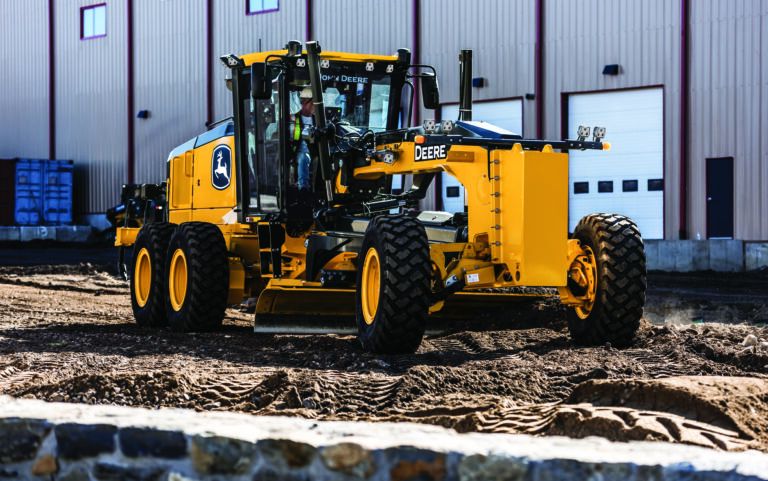
John Deere used ConExpo 2026 to unveil a sweeping refresh of its construction lineup for the US, launching eight updated P-Tier motor graders available with next-generation SmartGrade technology and three new Deere-designed mid-size excavators built around a new electrohydraulic system and purposeful technology
It is not often that an OEM overhauls two flagship product lines in a single show cycle. John Deere did exactly that at ConExpo 2026, rolling out eight P-Tier motor graders and three new-generation midsize excavators – with the excavator launch alone marking the largest product launch in the company’s construction division history – all built around a philosophy of “total design control” over every major system.
The motor grader range spans the 620, 622, 670, 672, 770, 772, 870 and 872 P-Tier models, covering four-wheel-drive and six-wheel-drive configurations with net engine power from 150– 280hp and operating weights from approximately 15,768kg to over 20,000kg. On the excavator side, the new 210, 230 and 260 P-Tier models cover the 21-28 tonne class, weighing in at roughly 23,300kg, 25,200kg, 27,400kg respectively.
Grading on their terms
John Deere first brought factory-integrated, mastless grade control to the motor grader market back in 2019, branding the system SmartGrade. The P-Tier update builds on that foundation, but Lauren Meyer, product marketing manager for John Deere motor graders, articulated dump trucks and scrapers, emphasises that the changes extend across the entire machine. “We started with a strong foundation for our motor grader, and then we focused on enhancing areas customers told us that mattered most to them. After extensive customer feedback, we made updates to the P-Tier cab, we integrated more of that technology, and then we brought in more automation features and our vision systems.”
“This is the largest product launch, largest testing period, largest number of preproduction test machines, you name it. It’s the biggest in our John Deere Construction division history”
Of those updates, the next generation of SmartGrade is arguably the most significant. Matt Costello, product manager for motor graders, has spent 12 years working on developing the grade control portfolio and sees the new system unlocking more jobsites with ease of use, flexibility, and productivity — principally because it now runs entirely on John Deere hardware and software, with the company’s own 10.1in G5 touchscreen display at its centre. “Having John Deere hardware and software gives us the control. It allows us to support, listen to customers, adjust accordingly and provide the solution updates we need to keep ourselves ahead of the game,” he says.
The new platform supports both Topcon and Leica grade control providers, with provisions for further expansion. Costello views the ability to switch between 2D and 3D on the fly as essential for mixed job sites. “If they’re running on the edge of a job site file and they want to blend in slopes, the operator can do that just by navigating the touchscreen display and activating the solution they want.”
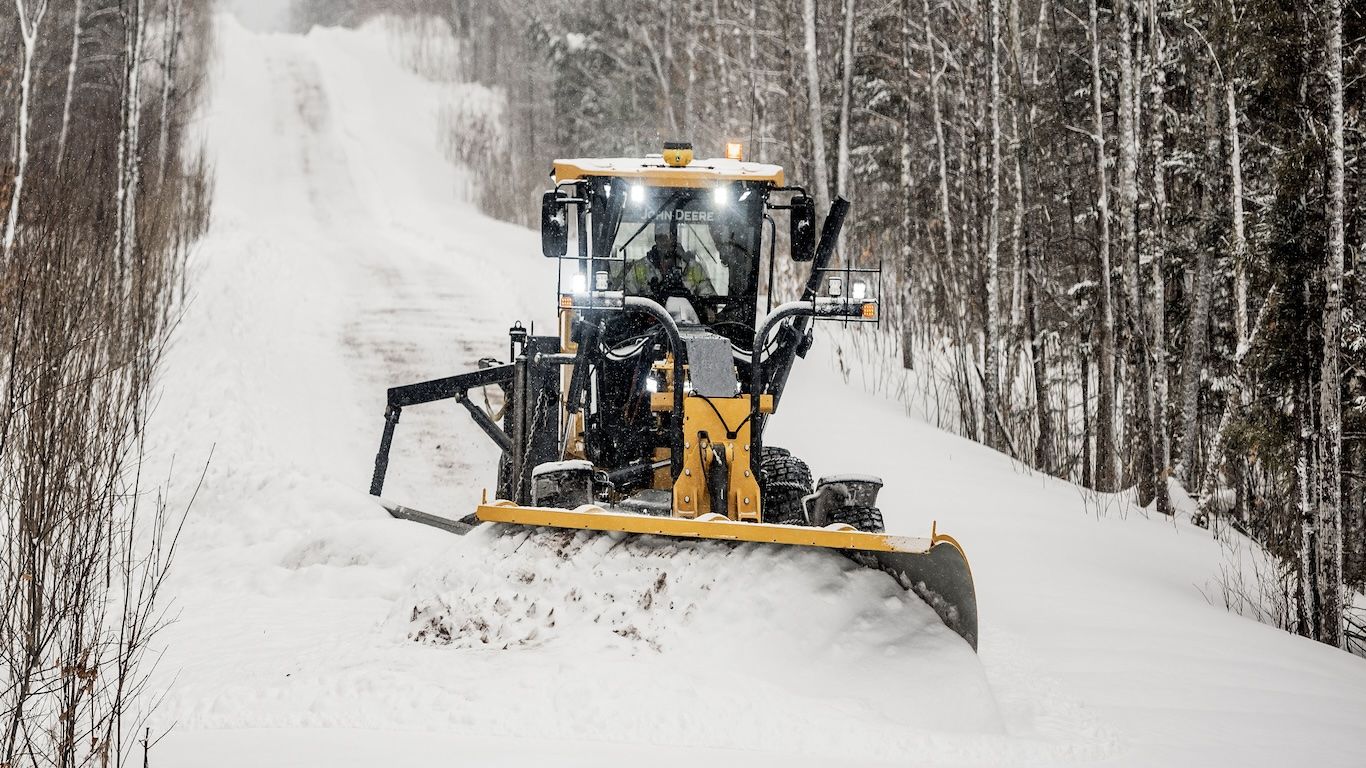
Another development allows operators to run full 3D grade control outside the centre saddle position – a limitation on previous models that restricted blade movement. “If they need to move that blade out, they can. It’s another movement that they can do within their job site to make sure that they can accomplish the task with that one machine and still maintain accuracy,” says Costello.
Automating the hard parts
Three new automation features join the P-Tier grader lineup alongside existing in-base functions such as autoarticulation, blade flip and machine presets. Cutting edge wear monitoring tracks blade position relative to the cutting edge, helping operations plan maintenance before costly damage occurs — and giving SmartGrade users a reference point to maintain 3D accuracy. Smart saddle, offered as part of Deere’s technology package rather than as an in-base feature, positions the blade into its optimum banked position at the press of a button — a task that typically demands years of experience to master manually.
“All these automation features are intended to help new operators to quickly become more proficient or provide a streamlined approach for more experienced operators to maybe have some shortcuts,” says Costello.
Intelligent blade control, part of the technology package rather than an inbase feature, automatically maintains a level cutting edge – one less variable for the operator to manage, and particularly useful for operators when adapting to a new jobsite or task. John Deere’s own studies with less experienced operators showed up to a 75% reduction in inputs for certain operations when the automation features were paired with SmartGrade — translating directly into less fatigue, higher productivity and more consistent output across a shift.
Cab design
“The core feedback that we received from operators was that they wanted a more spacious cab,” says Meyer. “All of the cab enhancements we made, such as the larger 8in touchscreen primary display, easily adjustable armrest and simplified six-wheel-drive controls, allow us to provide that operator comfort.”
An optional advanced vision system rounds out the package. The dual front alley camera gives side-toside visibility, while two rear-mounted cameras feature adjustable pan for broader situational awareness.
“The core feedback that we received from operators was that they wanted a more spacious cab”
Costello points to the practical reality of a machine that spends much of its working life on public roads. “Whether you’re pulling out of a maintenance shed, pulling on to a crossroad or you’re just simply navigating through a congested jobsite, the front alley cam gives the operator that important front side-toside visibility.”
John Deere Path, a mapping solution that uses StarFire positioning technology from the company’s agricultural division, also features across the range. Paired with SF-RTK for sub-inch accuracy, it maps road edges and boundaries in zero-visibility winter conditions. The technology has already proven its worth – one unit was used to escort an ambulance through a snowstorm on a night with no visibility whatsoever.
Digging deeper
The excavator programme was even more ambitious. “This is the largest product launch, largest testing period, largest number of pre-production test machines, you name it. It’s the biggest in our John Deere Construction division history,” says Justin Steger, product marketing manager, John Deere excavators.
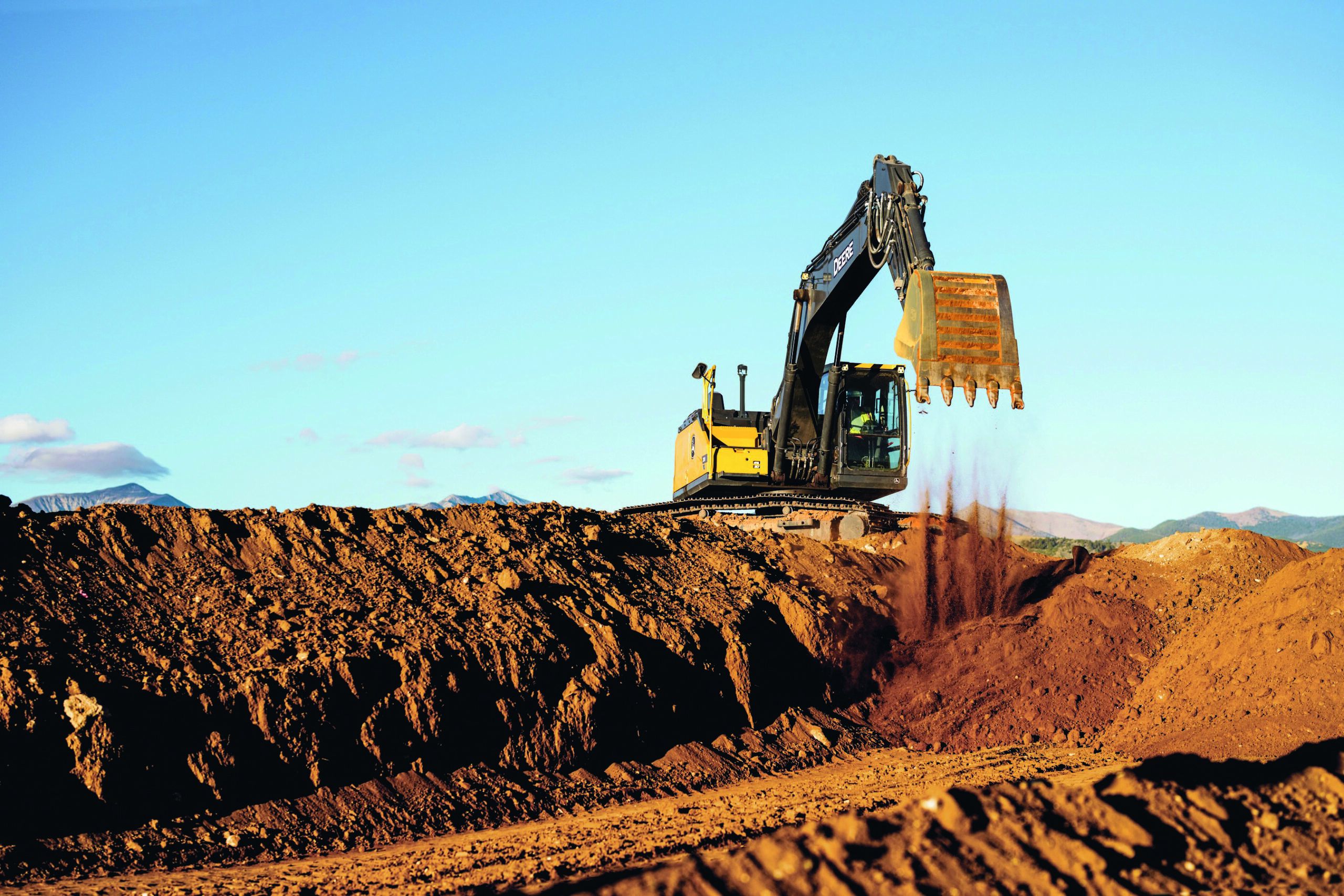
That testing programme has put over 155 pre-production machines on jobsites , accumulating more than 165,000 hours. “We know excavators, being as big as they are in this industry – you’ve got one chance, and you’d better get it right,” says Steger.
At the heart of the redesign is a shift from pilot hydraulics to an electrohydraulic system. Where the previous generation mechanically cracked valves to direct oil flow, the new machines use electronic signals to send oil where it is needed — faster and with less energy wasted. The gains are measurable: against the outgoing 210, the new model delivers 4% more productivity in bench loading while burning 7% less fuel. In trenching, it achieves 17% more productivity with 9% less fuel consumption.
“We’re from the Midwest, so we’ve got really clay-wet soil conditions that freeze over during the winter months. Now we can rip through that frost layer”
Those trenching figures reflect a particular emphasis on breakout forces. “We can break through all the different clays around the world,” says Steger. “We’re from the Midwest, so we’ve got really claywet soil conditions that freeze over during the winter months. Now we have the ability to rip through that frost layer, or we can pull trench boxes through the mud.”
Speed alone, Steger cautions, is not the measure of a good electrohydraulic system. “Customers love the speed, but they wish they had the control and metering capabilities of that pilot hydraulic system.” The new 210 P-Tier’s productivity figures reflect that priority – a 4% gain in bench loading, where precise swing control matters most, alongside a 17% improvement in trenching, where breakout force is the dominant factor.
Assisiting the operator
Each new model ships with 2D grade control in base. The 2D system includes an auto laser catch feature that continuously acquires the spinning laser reference without requiring the operator to pause. Steger sees the inclusion when paired with an optional laser catcher as a straightforward productivity argument. “Even when I track backwards, I can get another bucket of dirt, breaking the plane of the laser. The machine knows where it’s at again and can keep running continuously without delaying operations.”
Upgrading to 3D is designed to take less than half a day, with all harnesses pre-routed through the base machine. The next-generation SmartGrade system supports Topcon and Leica today, with Trimble arriving later in 2026 – and the operator interface mirrors the look and feel of equivalent standalone systems, eliminating the need for retraining. Steger recalls a conversation with one customer who summed up the value neatly. “We don’t train on production days. We train on rain days.”
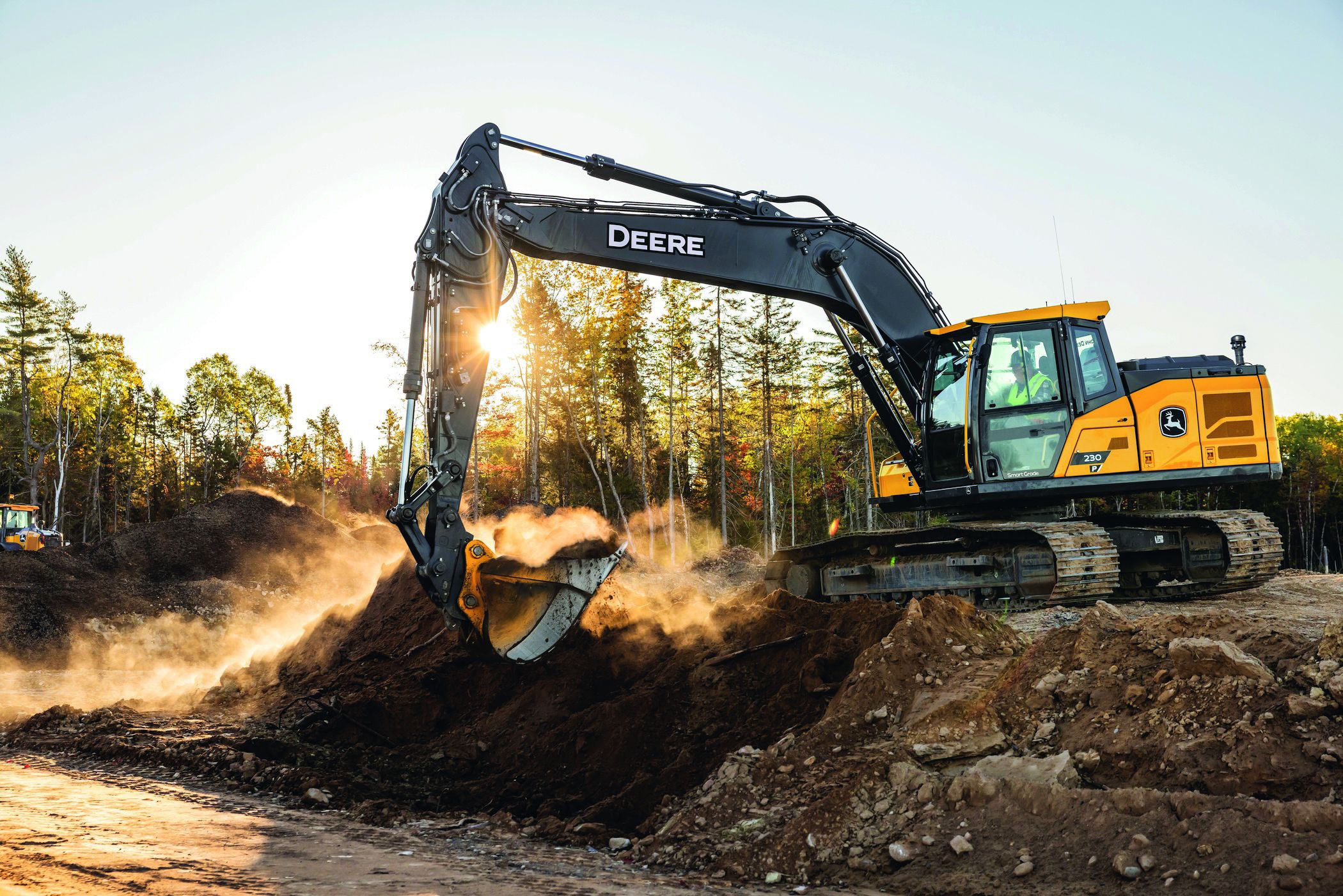
The completely new cab will share the same layout and interior volume across the full range from 14-50 tonnes, including reduced tail swing variants. A 10.1in G5 or 12.8in G5 Plus touchscreen serves as the primary display, complemented by a command arm with solid-state steel switches for operators who prefer physical controls. Customisable joystick buttons and individual operator profiles, secured by PIN, mean the machine remembers each user’s preferred setup.
Semi-autonomous features extend well beyond grade control. SmartWeigh dynamic weighing captures bucket tonnage automatically with just five degrees of swing. EZ Control simplifies precise horizontal and vertical implement movements for utility work.
Damage avoidance zones protect the boom, cab and front structures, while virtual swing fences keep the machine within a defined arc, critical for single-lane traffic operations. Remote Display Access (RDA) via the John Deere Operations Centre allows fleet managers to view or control the G5 display from anywhere with an internet connection.
Steger describes a scenario that illustrates the potential. “What if there’s a language barrier with that operator? Or that operator says, ‘I don’t have time to deal with this – just fix it for me.’ From my Operations Centre mobile app I can RDA in and see exactly what that display is showing my operator; I can request control and go in and change a setting in 30 seconds instead of giving a 10-minute explanation or having to make a trip out to the site.”
The P-Tier motor graders have been shipping since December 2025. The first three excavator models – the 210, 230 and 260 P-Tier – started production at the Kernersville, North Carolina factory in April, with machines expected on jobsites by the middle of the year. Further models across both ranges will follow shortly after – and if the scale of this launch is anything to go by, John Deere is putting the blade to grade and the bucket to dirt with intent.
Powering the transition
John Deere’s ConExpo presence this year in Las Vegas extended well beyond diesel. Grant Van Tine, product manager for electrification, laid out the company’s multi-pillar approach to future power – and is clear about the starting point. “We don’t think there’s one single solution that’s going to meet the needs of every customer in every application everywhere in the world.”
The company breaks its electrification strategy into two strands. E-Drive pairs a diesel engine with an electric drive system — a configuration first introduced in 2013, with seven construction models soon to be available. Crucially, E-Drive machines require no high-voltage battery, no plug-in charging and no special fuel. “It’s a very easy way for customers to integrate that into their fleet without disrupting their operation. They get benefits from electrification, like better performance, better efficiency, ease of operation – so they start to experience what electrification can offer,” says Van Tine.
E-Power — full battery-electric — targets customers seeking zero operating emissions. ConExpo saw the 310 X-Tier E-Power backhoe on display, incorporating battery technology from Kreisel. “We wanted to be able to optimise our vehicle designs by incorporating what we feel is really our own battery technology. We liked their experience and their focus specifically in off-road, high-duty-cycle-type applications,” says Van Tine.
Charging infrastructure remains the principal challenge. While battery-electric machines work well at permanent facilities with grid access and single-shift operations, many construction sites have little or no electricity available. Van Tine stresses collaboration over prescription. “The customers recognise this is a challenge and they really want to be part of the solution and not be told how something should work, or how it’s going to function in their operation.”
On the renewable fuels front, John Deere has approved HVO and renewable diesel as drop-in fuels for any machine running on petroleum diesel, alongside 30% biodiesel blends – up from a previous 20% limit. Performance is practically identical to conventional diesel, Van Tine confirms, offering an immediate emissions reduction for operators who prefer a fuel-based approach.
This article first appeared in the May/June issue of iVT