

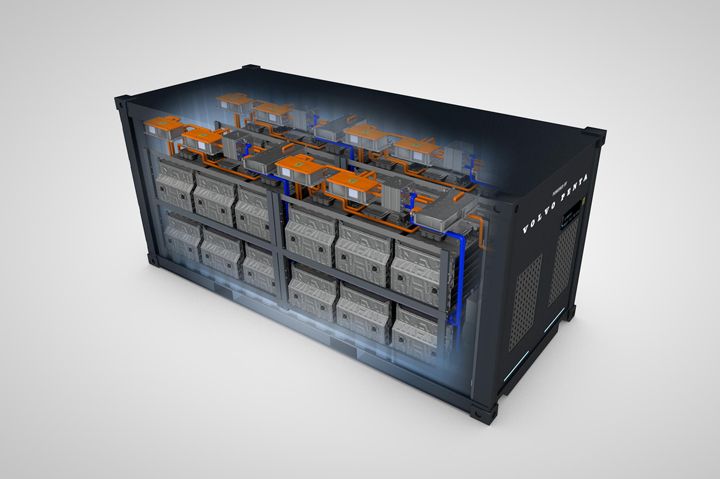
Volvo Penta is showcasing a battery energy storage system (BESS) subsystem at IAA Transportation 2026 in Hanover, Germany, built on battery technology already proven in Volvo Group’s on- and off-highway vehicles, and designed to bring fast charging to sites where grid capacity is limited.
Limited grid capacity and charging infrastructure remain a challenge in the transition to zero-emission transport, according to the company. Mobile battery-powered charging units are intended to help shorten deployment timelines and support fast-charging needs without relying solely on fixed grid connections, lengthy permitting processes or civil works – a scenario familiar to construction and other off-highway operators working temporary or remote sites.
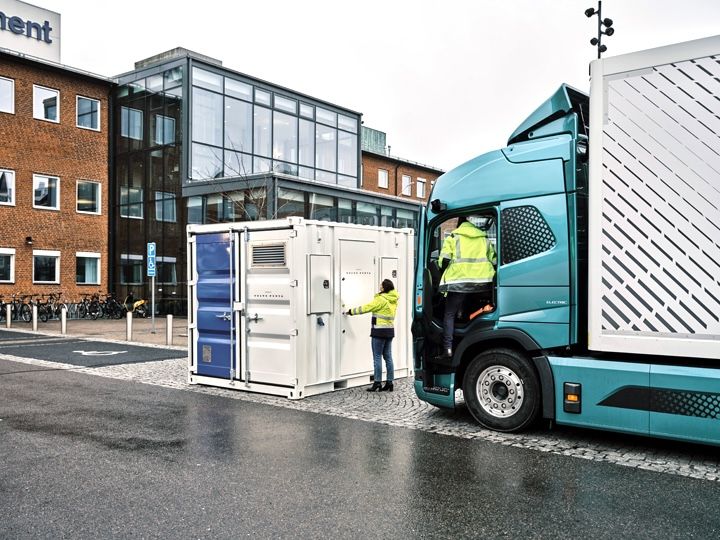
At its stand, Volvo Penta is showing its BESS subsystem alongside the Hivolt 380X, a complete, ready-to-deploy mobile BESS unit developed by Contour Advanced Systems and built around Volvo Penta’s battery technology. Volvo Penta is exhibiting alongside fellow Volvo Group company Volvo Trucks.
Battery technology shared with off-highway machines
The BESS subsystem draws on proven Volvo Group battery technology already used in on- and off-highway vehicles, extending it beyond Volvo Penta’s traditional marine and industrial engine business into transport and site electrification. It is engineered for the demands of continuous, heavy-duty use, combining a high energy-density battery pack with what the company describes as a favourable C-rate for fast charging and discharging, supported by a battery management system for performance, longevity and cybersecurity.
“Reliable power infrastructure is critical to the transition toward zero-emission transport,” says Tommi Wulff, sales and business development manager at Volvo Penta. “Battery energy storage can help bring fast charging to locations where grid capacity is limited or permanent infrastructure is not yet in place. At IAA Transportation, we are showing how Volvo Penta can support this transition by providing a proven, scalable BESS subsystem that our partners can build into complete charging and energy storage systems.”
Volvo Penta says the subsystem can provide flexible charging capacity for temporary locations, events or situations where charging is unavailable or disrupted. In fixed installations, the company adds, battery energy storage can also help boost limited grid connections and support high-power EV charging where demand is high – a use case that extends to construction sites, quarries and other off-highway job sites facing similar grid constraints.
Built through partnership
Volvo Penta is positioning the BESS subsystem as a foundation for partners to build into complete, market-specific energy storage systems, combining its battery technology and application expertise with partners’ own system integration and manufacturing capabilities.
According to Jacco Lemmen, business development manager at Contour Advanced Systems, Volvo Penta’s BESS subsystem provides “a proven battery foundation” for the Hivolt 380X. “By combining Volvo Penta’s technology with our system integration and manufacturing expertise, we are showcasing a solution designed and made in Europe, with European components and software, and built around shared values of safety, quality and cooperation,” he says.
Volvo Penta is a manufacturer of engines and power systems for boats, vessels and industrial applications, with a network of nearly 3,000 dealers across 130 countries. The company is exhibiting at IAA Transportation 2026, which runs from 15-20 September in Hanover, at Hall 11, Stand F31.