

Liebherr is advancing its digital strategy for construction equipment, combining AI-powered assistance systems, autonomous operation and connected machine data to address growing demands for productivity and safety on job sites.
Joachim Strobel, managing director sales at Liebherr-EMtec GmbH, and Eugen Schobesberger, managing director engineering at Liebherr-EMtec GmbH, from Liebherr’s earthmoving division spoke to iVT ahead of ConExpo 2026 where Liebherr will demonstrate its digital solutions alongside its machines under the motto “Hands on Future”.
Two converging pressures are shaping the company’s investment in digitalisation – the increasing density and complexity of construction sites, and a tightening supply of experienced operators. “If you look at the job sites of today, they are becoming more and more complex and congested with more machines, more people, tighter working spaces,” says Strobel. “The shortage of skilled operators continues to grow. Liebherr addresses this challenge by providing operator-centric assistance systems that enhance perception, support decision-making and improve consistency.”
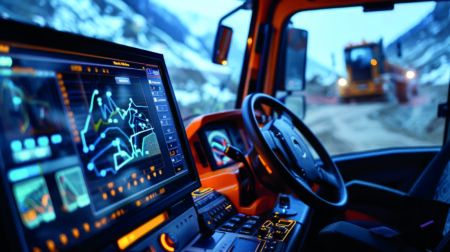
Among the systems being showcased at ConExpo is a 360-degree Skyview camera system, a bucket fill assist, and a people detection system that can distinguish between stationary objects and moving persons. In certain scenarios, the system is capable of halting machine operation automatically when a person enters the working area, which increases safety on construction sites.
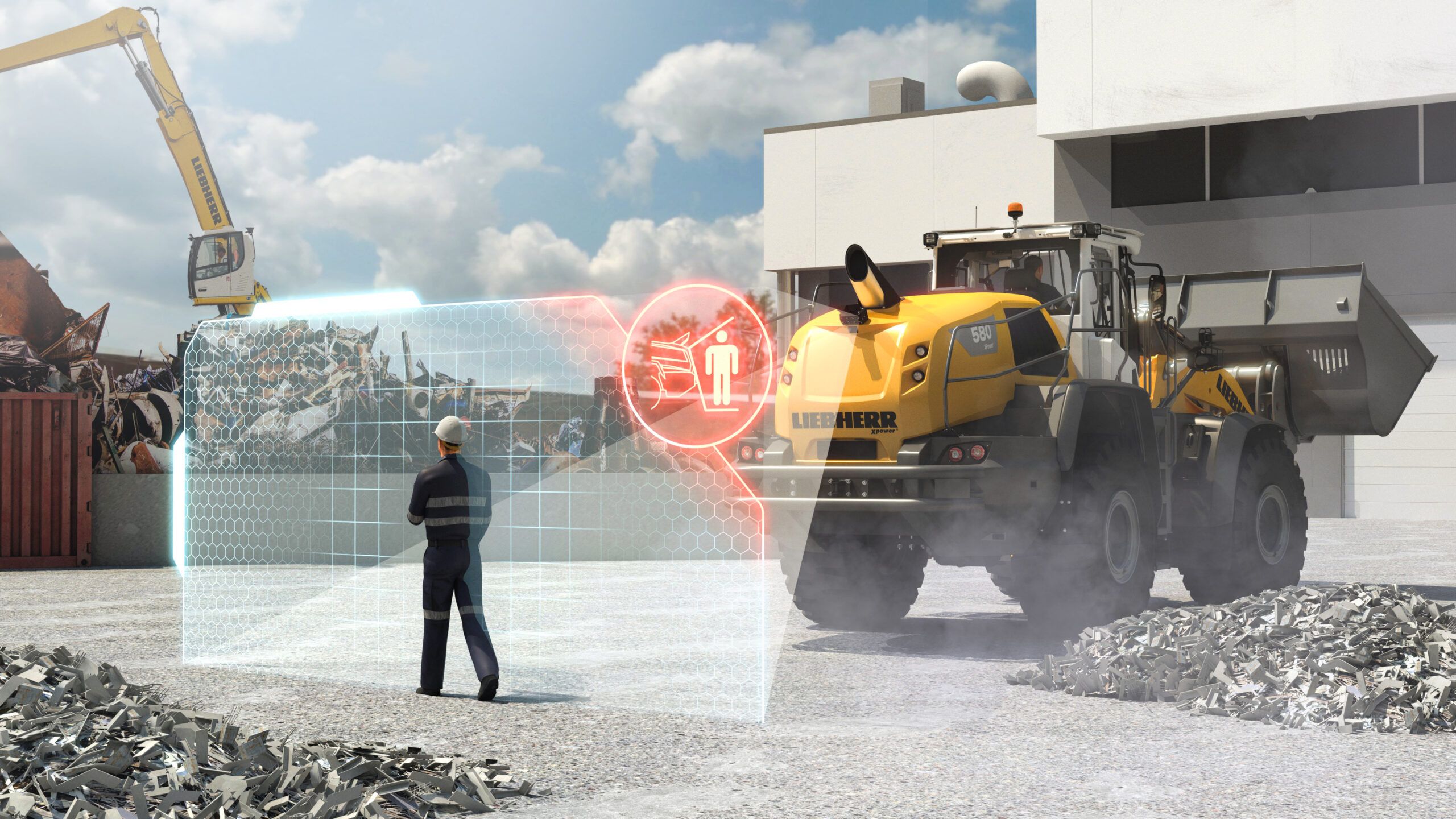
The bucket fill assist is among the systems powered by artificial intelligence, with the machine learning from cycle to cycle to improve fill levels while making the loading process more efficient and consistent. AI-powered people detection goes beyond standard cameras. It analyses live images in real time, distinguishes between people and objects, and delivers fast, precise warnings – reducing false alarms and increasing safety on site. Autonomous path planning, as demonstrated at Bauma last year, is similarly AI-based.
On the question of autonomy, Schobesberger acknowledges that fully autonomous operation remains constrained by mixed human-machine environments. “Whenever you are on a construction site where you have people and different machines, it is a greater challenge,” he says. However, he notes that in controlled, single-machine environments – such as gravel works or reloading areas where access can be restricted – fully autonomous operation is already achievable.
Strobel points to Bauma as evidence, where a Liebherr wheel loader loaded 18,000 tonnes of material fully autonomously within a protected area. He adds that the fundamental challenge in broader autonomous deployment is the intersection of human judgement and machine decision-making. “The machine decides basically on facts, on data – and this does not match together in all cases,” he says.
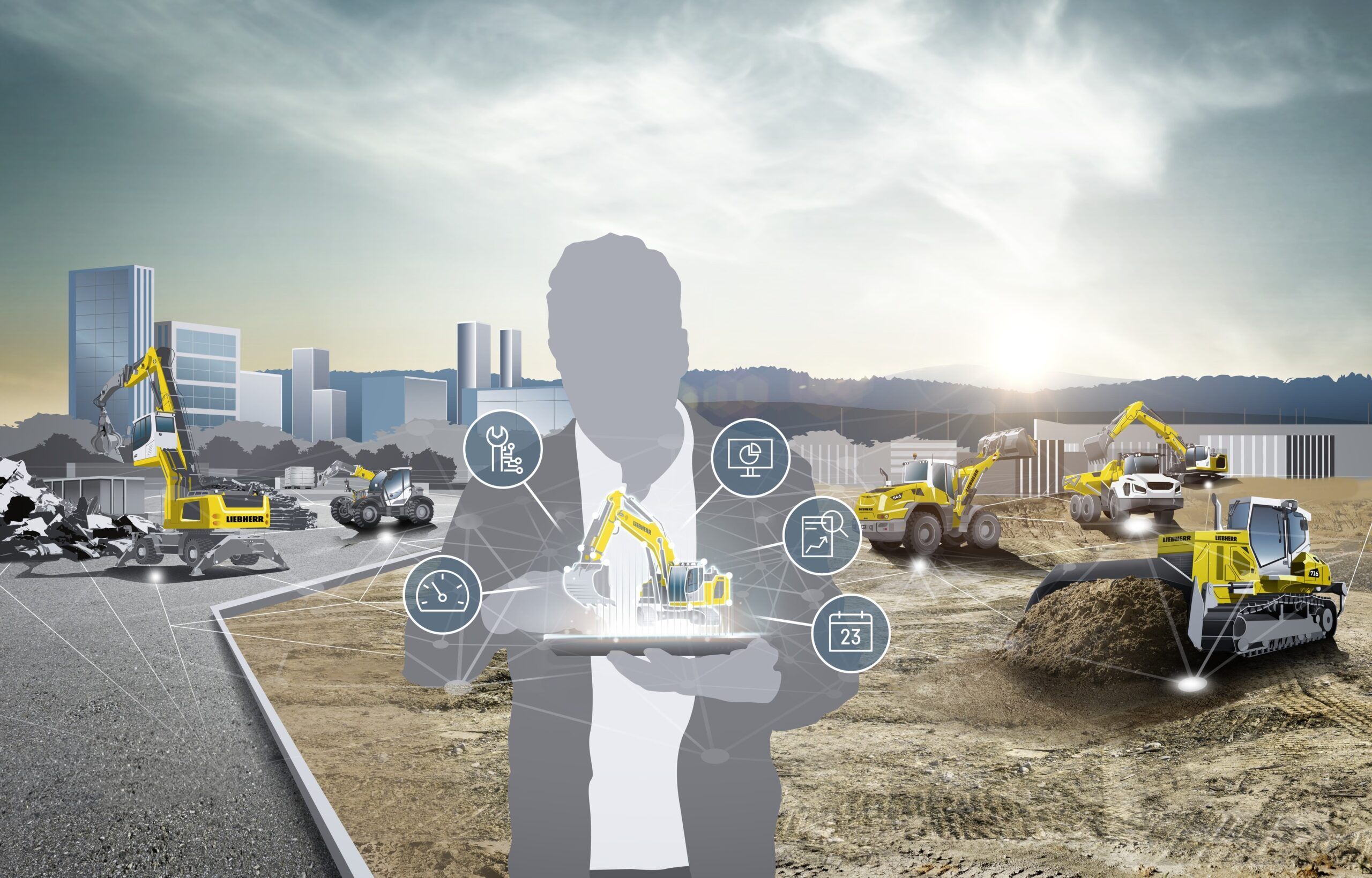
For connectivity and data management, Liebherr uses its Liebherr Connect system as the backbone for collecting machine data, operator inputs and process data. This feeds into the MyLiebherr platform, which provides detailed machine data, performance insights and condition information to operators, service personnel and sales teams. Schobesberger says artificial intelligence is used to convert this data into actionable knowledge for customers.
Addressing the challenge of varying operator skill levels, Strobel says the assistant systems are designed to raise performance across the board. “Our approach is not to replace operators, but to support them and raise the overall performance level,” he says. He adds that the systems also help experienced operators maintain consistent productivity over long shifts, and enable operators to work across different machine types within a fleet without requiring full retraining.
Looking beyond ConExpo, Strobel sees digitalisation enabling a fundamental shift in how job sites are planned and managed. “A job site will be organised more like an industrial process,” he says. “With AI and autonomous systems and digital systems, it will be possible to plan a job site much more precisely in future – where all processes are mapped in advance, like in industrial production.”
Liebherr will be demonstrating its digital solutions at ConExpo 2026 in Las Vegas this March, with a dedicated technology pavilion and daily live machine shows at its stand for in-depth technical demonstrations.
Images: Liebherr