

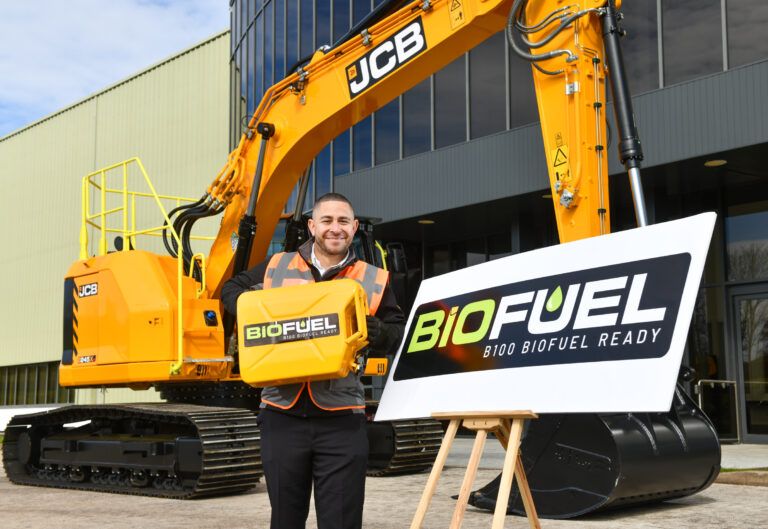
JCB has approved a 100% renewable biodiesel fuel for use in a range of its X Series tracked excavators, with the company set to become the first in the industry to deploy B100 biodiesel in tracked excavators sold in Europe.
The fuel, also known as fatty acid methyl ester (FAME), is derived entirely from renewable biological sources and can be used in newly manufactured JCB 140X, 145XR, 150X, 220X and 245XR models from June 2026. It contains no fossil diesel and is made from recycled vegetable oils through a process called transesterification.
“This milestone development is in direct response to major contractors asking for excavators capable of running on B100. They now have a practical fuel option that delivers genuine carbon savings and one that, in the future, could be extended to other products in JCB’s range, depending on demand,” says Richard Brooks, group product innovation director.
“The use of B100 biodiesel complements JCB’s market-leading battery electric and hydrogen combustion technologies as alternatives to conventional diesel power, providing customers with another route to carbon reduction and sustainable operation. Customers operating machines with Syntech ASB B100 can reduce greenhouse gas emissions by up to 93% compared to standard diesel, delivering an immediate and significant step towards net zero without compromising performance.”
Many engine suppliers have only approved the use of B10 or B20 biodiesel – fuels which are 10% or 20% biodiesel and 90% or 80% mineral diesel, respectively.
JCB has conducted an extensive test and validation programme in conjunction with Syntech Biofuel to allow X Series excavators to be operated with Syntech ASB B100 fuel. The fuel is compliant with BS EN 14214 and certified under the International Sustainability and Carbon Certification (ISCC) standard. JCB will provide full warranty cover for compliant B100 fuel when machines are specified with a B100 pack and supported by a JCB dealer B100 enhanced service contract. A conversion process also allows engines to be returned to conventional diesel operation, helping protect residual values and ensuring suitability for the used machinery market.
Image: JCB