

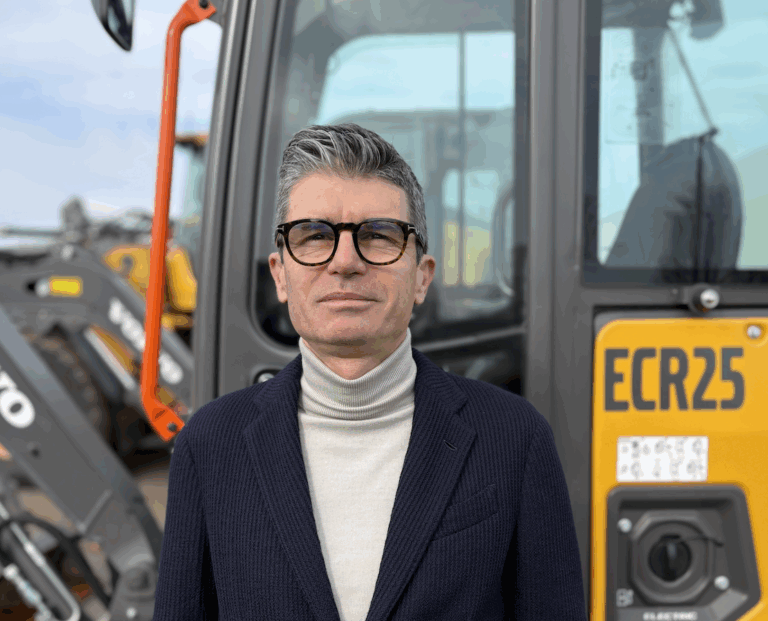
Stefano Tacchinardi has held a number of leadership roles at Volvo CE, including delivering stability in challenging markets as MD in Italy for 10 years, then, last year, he began a new chapter as head of sales for the compact business unit. We find out more about his vision for the future of this vital segment
Stefano Tacchinardi has spent three decades with Volvo CE. Now, as head of sales and channel to market for the Compact Business Unit, he’s leading the OEM’s global push in compact machinery, one of construction’s fastest-growing segments. With ConExpo on the horizon and a string of new compact launches behind him, Stefano Tacchinardi is clearly energized by his new role – though his journey here has been anything but direct.
When Volvo CE Italy was established in 2005, Tacchinardi became compact equipment director, spending three years in the role before moving to general purpose equipment and dealers director until 2012. After a period outside Volvo in an agricultural machinery business, Tacchinardi returned in 2015 as managing director of Volvo CE Italy – a position he would hold for over a decade. Italy suffered more than other Western economies following the financial crisis of 2008, experiencing a second recession triggered by a sovereign debt crisis from 2011-2013. “When I stepped into that role, the market was coming out of a very challenging period following the crisis and we were starting from a difficult position,” he says. “Over time, through a clear focus on people, customers and disciplined execution, we progressively strengthened the business.”
The transformation of Volvo CE Italy under his leadership stands as one of Tacchinardi’s proudest achievements. “Today, Volvo CE Italy has a strong and respected presence in the Italian market and represents a valuable asset for Volvo CE,” he says. “Being part of that transformation, and seeing the organisation grow in confidence, capability and performance, is something I am very proud of.
“On a personal level, what made this experience particularly special was the trust and support I received in the different roles I have held within the company. That trust gave me the freedom to take responsibility, make decisions, and perform at my best. The respect for people that Volvo stands for is not just a slogan – it is something I have experienced consistently throughout my career.”
Compact focus
In the second half of 2025, Tacchinardi moved into his current role as head of sales and channel to market for the compact business unit – a newly created position. “What motivated this step was a genuine desire to take on a new challenge, combined with the strong commitment I see within Volvo CE to further develop and grow the compact business globally,” he says.
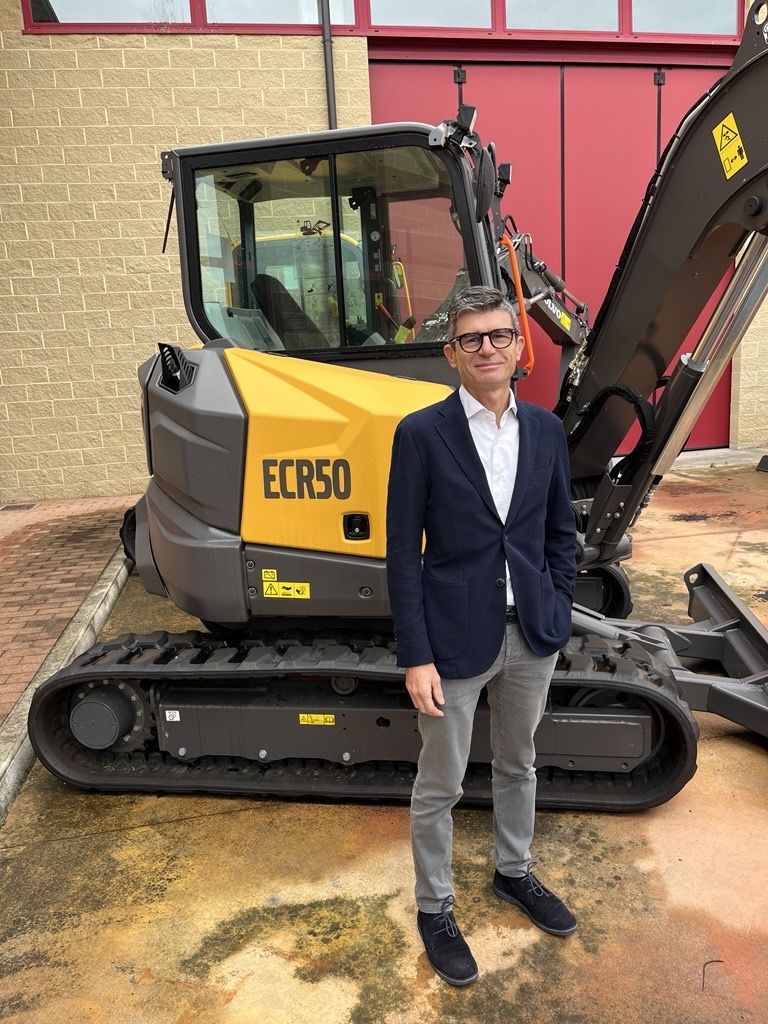
The creation of a dedicated compact business unit reflects the segment’s extraordinary growth. “Compact machines now represent around half of the global construction equipment market, and in Europe it’s closer to two-thirds,” says Tacchinardi. “It’s also one of the fastest-moving segments – customers expect quick delivery, flexibility and strong local support.”
Beyond market size, Tacchinardi sees the segment’s strategic importance for Volvo CE’s future technology direction. “Compact is where we see one of the biggest opportunities for electrification, especially in urban environments with tighter rules on emissions and noise,” he says. “Volvo CE has a strong head start here, but we need to keep moving fast to stay ahead.”
The strategic focus is already yielding results. Volvo CE has launched six compact models within a single year – a pace that Tacchinardi views as a clear market signal. “Compact is a priority growth area for Volvo CE and we’re putting real investment behind it,” he says. “Launching six updated or new compact models in one year shows two things: first, we’re listening closely to customers and moving quickly to bring improvements that matter day-to-day. And second, we’re serious about leading the shift to the future of compact machines – including electric solutions.”
Technology roadmap
Looking ahead, Tacchinardi outlines clear technology priorities rooted in Volvo CE’s core values. “Our technology priorities are firmly rooted in the Volvo DNA – quality, safety, and environmental care – and these values will continue to guide every product and solution we develop,” he says.
The approach is deliberately inclusive of multiple powertrains. “A key priority is the continued development of our product range across both internal combustion engine and electromobility solutions,” says Tacchinardi. “We see strong and diverse market requirements globally, and our approach is to offer customers the right technology for their application and market – whether that is highly efficient diesel solutions or zero-emission electric machines.”
Digitalization represents another major focus area. “We are progressively embedding innovative digital solutions into our compact machines through a new CoPilot platform, which will be introduced across the range,” says Tacchinardi. “This platform will enable smarter machine interaction, improved operator support and seamless integration of productivity, safety and efficiency features – all designed to make our machines easier to use and more productive on the jobsite.”
“Compact is where we see one of the biggest opportunities for electrification, especially in urban environments with tighter rules on emissions”
The new-generation ECR90, EC65 and EW65 excavators showcase these priorities in action. “Operators will feel improvements in all three areas, but if I had to pick what stands out most day-to-day, it’s productivity and ease of getting the job done faster,” says Tacchinardi. “These new-generation machines bring more engine power and higher hydraulic performance, which translates directly into faster cycle times, stronger digging and lifting performance and more versatility with attachments.”
The electric pathway
For customers still hesitant about compact electric machines, Tacchinardi offers pragmatic advice. “Start small but think big. The best way to begin is to identify a few projects you already know are well suited to electric – for example urban work, indoor or low-noise sites, utility jobs or projects with stricter emissions requirements – and then scale from there as confidence grows.”
“A great example is the latest ECR25 Electric – this new generation delivers double the battery runtime and can cover a full working day in many real applications. And when you factor in how much time diesel machines spend idling, electric often fits the working day even better than customers expect.”
The performance benefits are equally compelling. “In terms of performance, there’s no compromise – you get instant torque, lower noise and vibration, and of course zero emissions at the point of use,” says Tacchinardi. “The noise difference is huge. With the ECR25 Electric, it would take around 20 electric machines to generate the same noise as one equivalent diesel machine.”
Tacchinardi’s three decades with Volvo CE, combined with his track record of market transformation in Italy, position him well to successfully lead the global expansion of a segment that now represents the construction sector’s greatest growth opportunity. “The key is to try it, prove it on the right job, and then grow from there,” he says – advice that could equally apply to his own bold new chapter with Volvo CE.
This article first appeared in the February/March issue of iVT