

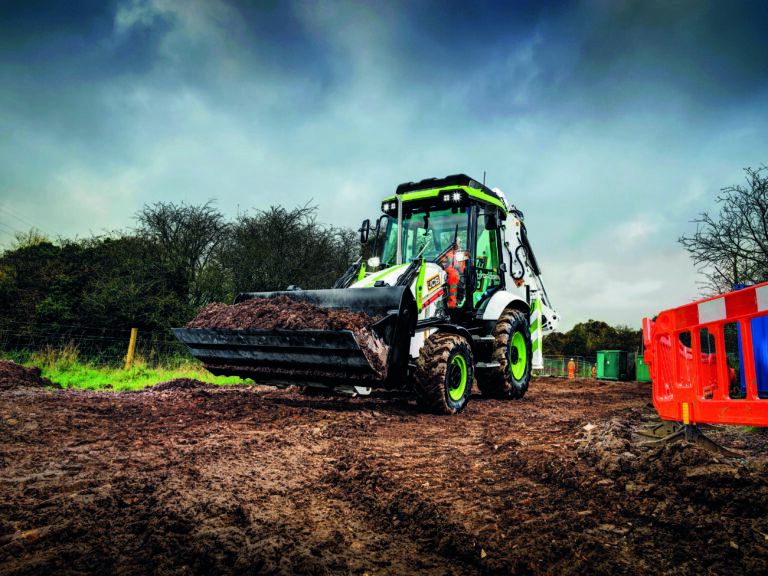
The JCB 3CX hydrogen, the cover story from iVT‘s recently-published July/August edition, is the world’s first production backhoe loader powered by a hydrogen combustion engine. Built on the 3cX platform, it delivers identical power and torque to its diesel equivalent with zero carbon emissions at point of use – the result of more than five years of development and over £100M of investment by JCB
The JCB 3CX is a machine so ubiquitous on construction sites that it became synonymous with the job itself. The hydrogen-powered version has been a long time coming – and the industry has been watching closely.
“Hydrogen presents a brand new opportunity for us. It’s a new fuel we can produce anywhere around the world, and fundamentally it’s a clean fuel. There’s no carbon in the fuel tank, so there’s no carbon at the tailpipe,” says Tom Beamish, JCB’s advanced projects deployment manager.
JCB has invested more than £100M in hydrogen combustion technology over more than five years, building over 150 hydrogen engines during the evaluation phase. The result is a machine that entered full production in May 2025 and has since received full EU Type-Approval for non-road mobile machinery – a first for any production backhoe loader in the world.
“There’s no carbon in the fuel tank, so there’s no carbon at the tailpipe”
For contractors and fleet operators the pitch is straightforward: a machine that performs identically to its diesel equivalent, runs on a clean fuel, and does not require the extensive operator retraining or infrastructure investment that battery-electric alternatives demand.
Familiar innovation
Step inside the cab of the 3CX Hydrogen and very little has changed. The electrical system runs the same 12-volt negative ground setup as the diesel, with wiring and connectors rated to IP69. Battery, alternator, telematics – all identical: 130A/hr, 900CCA, 90 amps, LiveLink standard across all models.

“Fundamentally, we’re offering the customers a very robust solution that gives the same performance as the diesel product, the same longevity, the same serviceability, but we’re doing that without the carbon,t says Mark Richards, principal engineer, JCB Excavators.
The guide-me-home lights still switch on for 30 seconds after parking. The six-speed autoshift gearbox with TorqueLock carries over, as do the all-wheel drive system and tyre sizes 12.5×18-10 front, 18.4×26-12 rear. For the operator, it is a familiar machine. Open the bonnet, and it’s still going to look largely the same – but with some crucial differences.
Under the hood
The 3CX Hydrogen, the generator line, and the land-speed record attempting Hydromax all share the same engine: the JCB 448 ABH2, a port fuel injected, 4.8-litre inline-four hydrogen combustion engine first unveiled at ConExpo 2023 in Las Vegas. It made its commercial debut in the G60RSH on-site generator before arriving under the bonnet of the 3CX Hydrogen earlier this year.

At 55kW and 440Nm of torque at 1,150rpm, its output closely mirrors that of the JCB Dieselmax 448 – and the shared designation is no coincidence. Both engines are built around the same 4.8-litre, four-cylinder architecture, a continuity that operators notice immediately behind the controls.
“In the engine itself, we’ve still got the traditional elements of a combustion engine – the block, the bed plate, the sump. The change is really in the hydrogen combustion. We have a slightly different cylinder head, to package our spark plugs,” says Richards.
That change is driven by a fundamental property of hydrogen: unlike diesel, it does not ignite under compression and requires a spark instead. The 448ABH2 runs four spark plugs, one per cylinder with fuel delivered via the intake manifold rather than injected directly as on a diesel.
“We’ve got our common fuel rail across the top – a single reservoir feeding all cylinders,” says Richards. “There are slight changes to the way we manage the airflow into the engine. We have a different turbocharger, designed to spin at very high rpm, which allows us to get a lot of air into the engine.”
Although stored aboard at 350 bar, hydrogen enters the cylinder at relatively low pressure. This is deliberate. Decompression itself generates heat, and premature ignition before the fuel-air mix is correct – known as preignition – is a genuine risk with hydrogen given its extremely low ignition point. Low-pressure port delivery keeps combustion controlled and precise.
“We have a different turbocharger, designed to spin at very high rpm, which allows us to get a lot of air into the engine”
The downstream benefits are straightforward. On a diesel engine, the cylinder is where the emissions problem begins – everything that follows, from exhaust filters and catalytic converters to diesel particulate filters and AdBlue systems, exists purely to treat what combustion produces. With hydrogen, the primary byproduct is water vapour. All of that ancillary hardware simply goes away.
In the tank
The other major divergence from the standard 3CX is visible the moment you look up. Three composite-wrapped cylinders sit on the cab roof – each one an aluminium inner liner wrapped in multiple layers of carbon fibre, built to contain hydrogen at 350 bar.

That’s considerably more than a scuba tank, which typically holds around 200 bar, though well below the 700 bar of a Toyota Mirai, where higher pressure allows more fuel in a smaller space for long-range driving.
The roof location is a packaging solution. On a diesel 3CX the fuel tank sits low on the frame, but hydrogen tanks demand significantly more volume and couldn’t be accommodated there without a full chassis redesign. The roof works, though it comes at a cost: the centre of gravity is higher, with a modest effect on overall stability. For most backhoe applications it’s an acceptable trade-off – but it’s worth noting.
Refuelling
None of this would matter without a credible on-site refuelling system. Besides matching the diesel engine’s performance, an advantage of hydrogen over battery-electric is the capacity to operate without the need for any grid access.
JCB doesn’t handle the refuelling system directly, but through HyKit which is a joint venture between private equity investment fund Hycap, clean energy group HydraB, and JCB – which they refer to as a “strategic alliance” on their website. It’s a recently formed company, launching commercially in 2025. Its Mobile Hydrogen Refueller the MHR-X75 was co-launched with the Hydrogen 3CX in May.
“It’s a full hydrogen refuelling station that we’ve condensed. We mounted it on a trailer and kept the under three and a half tonnes – so it can be turned around by a pickup truck. That’s important because machines like this need to bring the fuel to where the machines are operating,” said Dr John Vickers, HyKit’s director of engineering.
A nozzle connects the HyKit to the 3CX, then pressure differential does most of the work. The flow is managed electronically to ensure that it delivers a controlled, safe fill. The touchscreen integrates safety with improtant features such as leak detection, pressure monitoring and emergency shutdown systems. It’s certifed TPED, ADR, and UK CDG and a cloud connection is included in order to enable remote monitoring and diagnostics.
“In this unit we store 75 kilograms of hydrogen, and that is stored at 635 bar, depending on temperature variations,” says Dr Vickers.
On fixed hydrogen refuelling stations for on-road vehicles, precooling is standard. Ambient heat affects the refuel speed, with cooler temperatures enabling a snappy 5 minutes, while a hot summer’s day will push it up to the higher of 15 minutes. Again, rapid decompression pushes the thermal limits of hydrogen, so the extra time when the starting temperature is higher is about keeping that rise within safe operational limits.

A clean fuel for uncertain times
With no CO2 at the point of emission, NOx is the only meaningful pollutant a hydrogen combustion engine produces – and this was originally one of the stronger arguments against it. Even that concern has been dramatically reduced by burning the fuel at lower pressure and temperature than earlier engine designs.
“The primary driver for considering alternative ways to power JCB machines is the need for action in response to climate change and eliminating the use of fossil fuels,” says JCB’s spokesman Nigel Chell.
Ultimately, the environmental credentials are only as strong as the production method behind the fuel. Some hydrogen is produced from methane, some entirely from renewables. That distinction sits outside the hands of OEMs like JCB – but the benefits of a clean construction site can be felt immediately, by workers and members of the public alike.
“It’s a full hydrogen refuelling station that we’ve condensed. We mounted it on a trailer and kept it under three and a half tonnes so it can be turned around by a pickup truck”
Increasingly, though, the arguments are mounting on grounds beyond environment alone: cost, supply, and volatility. Pump prices are rising and uncertain, and there is a global push towards more localised, secure energy sources.
“As energy systems around the world adapt and change due to ongoing global issues, there is renewed interest in alternative fuels from the perspective of energy security and lack of supply of fossil fuels,” says Chell.
Today, hydrogen costs more per day to run than diesel – but the trajectory of each is heading in opposite directions. The Celtic Sea wind-to-hydrogen project (Project Dylan) is forecasted at £1.50/kg by 2040, which on an energy-equivalent basis would make hydrogen roughly 35% cheaper than red diesel costs.
The Hydrogen 3CX and other applications of the 448 ABH2 represent a bold new direction for the OEM, and JCB has clearly committed hard to this new and innovative technology. This is positive news for the environment, and potentially for the savvy, forward-thinking construction company as well.
Hydrogen safety
As with any novel technology, the anxieties surrounding safety tend to come to the forefront – while the risks of the familiar are often tolerated. Hydrogen is no different, and there are some genuine differences worth understanding.
At ground level in open air, hydrogen is remarkably well-behaved. It is significantly lighter than air and disperses upward rapidly, which is precisely the property that makes its primary safety mechanism work. Thermally Activated Pressure Relief Devices (TPRDs) are designed to vent hydrogen away from the tank and critically away from the operator in the event of a fire.
Even if vented gas ignites, this is not necessarily the worst outcome. A controlled jet fire outside the tank is a known, manageable hazard. A rupturing tank is not. This is something liquid fuels fundamentally cannot offer – spraying petrol or diesel away from a vehicle under pressure would turn an accident into a disaster. With hydrogen, directional venting is actually a viable safety strategy.
Where the open-air advantage disappears is in confined or cluttered environments. Scaffolding, structures, dense foliage, and enclosed storage or parking areas can trap rising hydrogen gas rather than allowing it to disperse.
The additional complication is that hydrogen is both invisible and odourless – there is no smell, no colour, and no smoke to betray a leak. Ignition can occur at concentrations above just 4%, triggered by nothing more than a small spark. The most credible safety risk is therefore an undetected slow leak in a confined space, accumulating at ceiling level and then igniting.
The practical conclusion is that hydrogen combustion plant is at its safest in open, unobstructed environments, and that any deployment in confined or semi-enclosed conditions demands careful risk assessment.
Training is an important part of the picture. Qualifications such as the IMI Award in Hydrogen Vehicle Awareness give operators a grounding in the specific hazards hydrogen presents. It is worth noting, however, that formal hydrogen safety training is still largely built around stored hydrogen infrastructure and fuel cell systems – the hydrogen combustion engine is new enough that the training landscape is still catching up with it.
This article first appeared in the July/August issue of iVT