

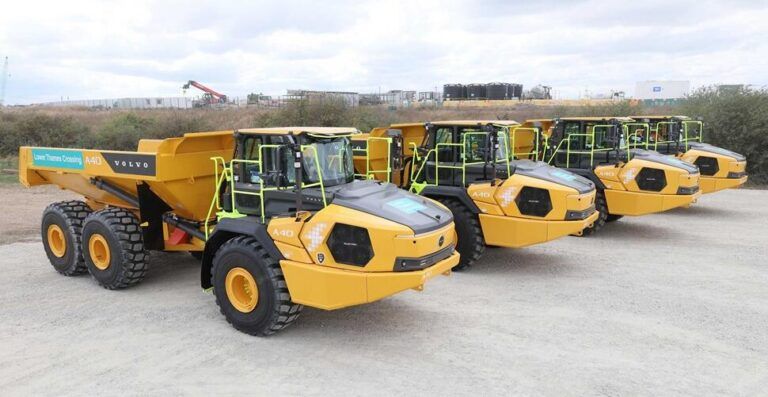
The Volvo A40 Electric has become the first battery-electric articulated hauler in its size class to work on a major UK infrastructure project, with four of the machines now in service at the Lower Thames Crossing.
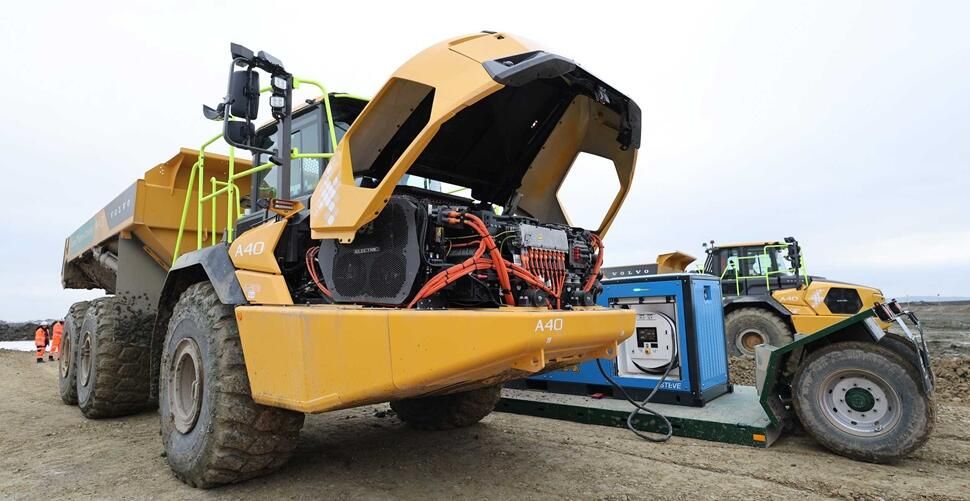
The A40 Electric carries a 39-tonne payload and runs on a 540kWh lithium-ion battery pack, giving it around six hours of operation on a single charge, depending on application. Fast charging from 10% to 90% takes around an hour using a 350kW charger, while regenerative braking feeds energy back to the battery during operation. Operators use the same controls as on the manufacturer’s diesel haulers, with lower noise and no exhaust emissions.
The machine is the world’s first battery-powered articulated hauler in its class and forms part of the growing battery-electric range from Volvo Construction Equipment (Volvo CE). It arrives 60 years after the company built Gravel Charlie, the world’s first articulated hauler.
Four A40 Electric haulers have been delivered so far, reaching the Essex worksite this autumn from Volvo CE’s production site in Braås, Sweden. They are building the foundations and structures for the road and the entrance to the new tunnel under the Thames.
On site, the haulers are charged using electricity from generators fuelled by British-manufactured green hydrogen. Running this way, they produce no exhaust emissions and are noticeably quieter than combustion machines, improving conditions for workers and for the communities around the site.
“The Lower Thames Crossing is a showcase for low-carbon construction in action,” says Darren Fitch, head electromobility sales Europe at Volvo CE. “Our Volvo A40 Electric haulers are operating on one of the industry’s most visible and demanding projects, proving that electrification can meet the demands of major construction projects. Contractors no longer need to choose. They can achieve zero-exhaust emission operation while benefiting from lower noise, safer worksites and a lower total cost of ownership. When the industry can see that firsthand, perceptions change. Projects like this don’t just demonstrate what’s possible today, they help reshape expectations for tomorrow.”
The Lower Thames Crossing will run for approximately 14.3 miles, including 2.6 miles of tunnels under the Thames, connecting Kent and Essex and almost doubling road capacity across the river east of London. It is set to be the first major infrastructure programme in Britain built with carbon-neutral construction: diesel has not been used on its worksites since 2025, and the tunnel and roads are being built only with HVO, electric and hydrogen-powered machines. More than 2,500 people work on the project, and the new road is expected to open in the early to mid-2030s.
“Going electric today is no longer about compromise, it’s about the benefits,” says Shaun Pidcock, Lower Thames Crossing programme director. “These remarkable machines show that even the heaviest jobs can be done cleanly, and in a way that is better for those working on or living near our sites. By using the next generation of construction machinery to make the Lower Thames Crossing Britain’s greenest road today, we are helping the industry set a new standard for tomorrow and make diesel-powered sites a thing of the past.”
Image: Volvo CE